The Gut-Brain Connection: Why Your Mood, Energy, and Clarity Start in Your Stomach

Scientists now call the digestive tract your "second brain" — and for good reason. There are more nerve cells in your gut than in your spinal cord, and about 90% of your body's serotonin, the chemical that steadies your mood, your sleep, and your appetite, is made in your gut rather than your head. I understood this gut-brain connection long before it had a scientific name. I always said that disease starts in the digestive tract — and I didn't mean heartburn and bloating. I meant everything: mood, energy, immunity, and clarity. In this article I'll show you how your gut talks to your brain, the five things that break that conversation, and how to restore it.
What's Actually Happening Between Your Gut and Your Brain
Most people treat the gut and the brain as two separate things. They are not. They are wired together, and the wiring runs mostly one direction — upward.
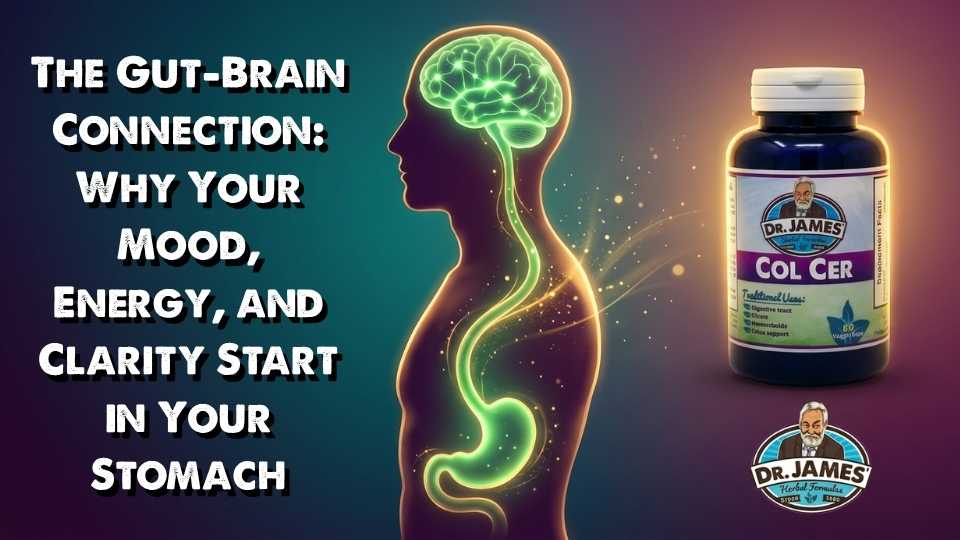
Inside your digestive tract is the enteric nervous system — the network of nerve cells that runs your digestion and operates independently of your brain. It reports up to the brain along the vagus nerve, the main communication highway between the two. And here's what surprises people: about 90% of the signals on that nerve travel from the gut to the brain, not the other way around. Your gut is constantly telling your brain how things are going down below — whether there was enough food, whether it was nourishing, how your stress response should be set. When that highway gets blocked or overwhelmed, it's like a major accident on the freeway: everything behind it slows or stops. (This is the same whole-system thinking that runs through all of Dr. James' work)
I see it in my own family. My wife Lynn has hypoglycemia, and when she goes too long without food she'll tell you her brain simply isn't functioning. But it's not only the empty stomach — overeating, especially the wrong foods, does it too. Processing a heavy, poor meal takes so much of the body's energy that there's nothing left over for thinking, for patience, for tolerating noise or stress. The stomach is tied to everything else.
Why a Damaged Gut Means a Struggling Mind
When the gut is inflamed, depleted, or out of balance, it cannot produce serotonin properly. And a gut that isn't making serotonin properly produces exactly the symptoms people chase as separate problems: brain fog, anxiety, mood swings, poor sleep, fatigue.
Adults can often catch it. I can usually say, "I ate too much," or "I ate the wrong thing," and connect the dots. Children can't. It just shows up in their demeanor, their attitude, their tolerance — and then they're sent to school to push through a full day with far more social pressure than most adults face, and we expect them to hold it all together. Years ago I heard someone make the case that children who lash out emotionally are very often dealing with a digestive issue at the root, not a character problem. There's a great deal of truth in that.
I watched the same principle work in reverse with Lynn's great-grandparents. When Grandma and Grandpa Hunt grew old, they drifted from the garden food they'd eaten their whole lives into canned and instant food — and declined. The moment their diet was cleaned up and they were getting enough real food again, it made a night-and-day difference. Their minds cleared. They became different people. Restore the digestion and you restore the person.
This is exactly why, when someone came to Dr. James with a long list of complaints, he would start with whichever system was bothering them most — usually the digestion. Clean that up and it tends to clear several other things at once. The anxiety, the brain fog, the low mood: a cascade effect, all downstream of the gut.
The 5 Things That Break the Gut-Brain Connection
Here are the five things I see damage the gut and shut down healthy serotonin production:
- Ultra-processed food. It doesn't digest correctly, it's stripped of fiber, and it doesn't just fail to feed your microbiome — it depletes it. The preservatives, the bleached and altered ingredients, the oils used to make food shelf-stable: outside bugs won't eat it and weevils die in it, so why would the organisms in your gut survive on it? They can't. The amount of ultra-processed food in your diet correlates directly with depression, anxiety, cognitive decline, heart disease, and diabetes. Dr James always said white store bread is what plumbers use to clog a pipe while the glue dries — squeeze it into a ball, jam it in, and it stops the water flow. It does the same thing in your digestive tract.
- Sugar and refined carbohydrates. White sugar, white flour — here in New Mexico, white tortillas. The single change that turns people's lives around is getting rid of the white stuff. Sugar and refined carbs feed Candida overgrowth, which crowds out the good microbes that digest your food. Worse, as Candida feeds it off-gasses waste that's punishing on brain fog — like fumes from a sewer line intoxicating the brain — and it makes you crave more sugar and white food. It's a vicious cycle. When you're craving sugar, it's often the Candida saying feed me. (For the full picture, see our article on Candida.)
- Antibiotics. An antibiotic doesn't care what it kills — it kills indiscriminately, the bad and the good together. That's the key difference from a formula like FECTION, which targets the harmful microbes while letting the good ones flourish. Most people notice the immediate relief — the fever breaks, the infection clears — and then forget to rebuild the gut afterward. On children, whose hormones and systems are still being built, the damage to the gut is significant. If you do need antibiotics, and sometimes you do, reintroduce the good cultures consistently afterward and expect it to take a few months to bring the balance back.
- A depleted microbiome with nothing replacing it. Your digestive enzymes come from the very food you eat, and they get used up doing their work. Eat food stripped of those enzymes and you never replenish them — which is part of why people develop trouble digesting whole categories of food.
- Chronic stress. The stomach is where stress is held — ask anyone with ulcers. Stress lowers serotonin, low serotonin raises stress, and around it goes. And when people are stressed they reach for exactly the sugar and refined carbs that feed the cycle. Nobody under stress says, "I think I'll eat a carrot."
How to Tell Your Gut Isn't Talking to Your Brain
Watch for these signals that the gut-brain connection is off:
- Brain fog — trouble concentrating, feeling mentally slow
- Anxiety that comes from nowhere — the gut sending stress signals to the brain with no external trigger
- Mood swings — fine one moment, cranky the next, a sign serotonin isn't being produced correctly
- Chronic fatigue — the kind where there's no "fake it till you make it," like the wall you hit after a heavy load of the wrong food
- Poor sleep — which loops straight back into fatigue
- Cravings — for soda, sugar, white food: the bad bugs demanding to be fed
- Depression — not always, but very often there's a real gut connection worth investigating
None of this means every mental-health struggle is a digestive problem — it absolutely isn't, and there are times medication is a genuine help. But treating the mind while ignoring the gut can be like fanning the smoke and never looking for the fire. If you're supporting your emotional health, support your gut alongside it.
The Formulas That Support the Gut-Brain Connection
Diet does most of the work — I'll come to that — but the right formulas give a depleted system the materials to rebuild. Here's how I think about each one.
COL CER is the one I reach for first. It works, as I like to say, from the lipstick to the toilet paper — the whole digestive tract. It soothes and supports the stomach lining where ulcers start, helps release waste stuck in the folds and bends of the colon, and gives the gut the nutrients it needs to function. If you're depleted, give it time to rebuild the system rather than expecting one capsule to change your life.
KOLONIC KAPS is the fiber formula that sweeps out the corners — psyllium husk to bulk and move things along, plus apple and grapefruit fiber that absorb toxins and dead material (including dead Candida), and diatomaceous earth, which detoxifies the colon and helps clear intestinal parasites. You can be exposed to parasites almost anywhere without knowing it, so this is worth keeping in your routine as regular maintenance.
ZIME is the one most people underuse. They wait until the gut has already thrown a fit — but ZIME works best before a meal you know you'll struggle to digest. It supplies the building blocks for digestive enzymes and creates the right stomach environment so food breaks down properly, without the side effects of the digestive aids sold everywhere else. You can take it before every meal if you want. It's also loaded with green, mineral-rich plants, which makes it a real help for people who don't eat their vegetables well — think of it as adding digestive greens.
A word on antacids here, because ZIME replaces a habit a lot of people lean on. An antacid is essentially a mineral, used to adjust stomach pH — but the body already uses minerals to regulate that pH on its own. If you're mineral-deficient, you can't pull from nothing to create the digestive environment you need. Rather than reaching for a chewable tablet with undisclosed binders, it's often better to give the body the actual minerals. We found with our own grandson that a capsule of PM Minerals+ or potassium — whichever he was short on — did what the antacid was trying to do, because he was simply deficient. Minerals are the foundation that lets the whole gut biome come back.
LIV CLEAN supports the liver, which is the body's filter — it cleans the blood and metabolizes everything so the body can clear it. Picture a dish rag you never rinse: eventually it's too foul to clean anything. A liver constantly working through ultra-processed food is that rag, and a backed-up liver lets toxins build up everywhere. LIV CLEAN supports it through that load. Some people choose to take it long-term simply because of how they eat; it's a reasonable option, and far better than trying to sprinkle bitter herbs like mandrake, gentian, dandelion, and goldenseal on your dinner.
KLEAN LAX is the one that comes with a caution. It's a laxative — not addictive, you can't get hooked on it, but it isn't meant to be a daily crutch so you can eat whatever you want. For some people it's a genuine miracle: we know a woman in a wheelchair whose bowels don't move without it. The key is Dr. James' phrase bowel tolerance — start at the bottom of the scale, one capsule, and build up only until you reach the effect you want. Unlike most of our formulas, where more is fine, with KLEAN LAX more can be something you regret. (One family member once took six KLEAN LAX instead of six allergy capsules by mistake and spent a memorable night learning what "bowel tolerance" means.) Start small and slow.
NERQUILIZER isn't a digestive formula, but it belongs in this conversation. It nourishes the nervous system and supports the body's serotonin production, feeding the nerve tissue around the vagus nerve so that gut-to-brain communication can happen cleanly. And because it has to travel through the gut to reach every system that needs it, it nourishes the nerve endings in the gut first. When the emotional side is prominent — anxiety, low mood — COL CER plus NERQUILIZER together make a real difference, with FECTION added if the gut biome itself is off and PM Minerals+ as the mineral foundation.
What To Do About It — A Practical Path Forward
You can take all the herbs you want and ignore the problem, or you can change your diet and let the herbs carry you the rest of the way. Without the diet, the herbs only go so far.
- Cut the white, ultra-processed food. If it's white and pasty, leave it alone. Color means nutrients.
- Add whole grains back. Dr. James believed the rise in couples unable to conceive traces in part to the wheat germ being stripped out of refined grain — the reproductive part of the plant, removed.
- Use good oil — raw coconut oil, not MCT. Coconut oil supports the microbiome, helps move toxins out, and fuels the liver. But it has to be raw, unfiltered, steam-distilled coconut oil. MCT oil — the kind that stays runny — has had the very fuel the liver burns processed out of it, so it bypasses the liver and does nothing for it. Don't be fooled because the label says "coconut."
- Eat real fermented foods — with one caution. Kefir, real yogurt (not the kind cooked until the bacteria are dead), and sauerkraut are excellent for the stomach. But some guts are in too dire a state to tolerate fermented foods at first; if your body reacts badly, that's a sign of an underlying issue to address with your physician rather than push through.
- Eat leafy greens — in moderation. Dark leafy greens are wonderful, but don't overdo them. A daily smoothie packing a week's worth of spinach concentrates iron and roughage to the point that it can actually slow your bowels down. A hundred years ago no one could eat that volume of greens year-round; it's the law of moderation. Variety and balance.
- Make changes you can keep. A little at a time beats going crazy for a week and quitting.
- Support the system with formulas as described above — and if you're feeling any of this, give it an honest 30-day try and see what changes.
Listen to your body as you go. Any formula that cleanses quickly should never push too hard — if your bowels get carried away, ease off and drink more water.
Frequently Asked Questions About the Gut-Brain Connection
Where is serotonin actually produced?
About 90% of the body's serotonin is produced in the digestive tract, not the brain. Serotonin helps regulate mood, sleep, and appetite, which is why a gut that's inflamed, depleted, or out of balance and unable to make serotonin properly often shows up as anxiety, mood swings, and low mood.
What is the vagus nerve's role in the gut-brain connection?
The vagus nerve is the main communication highway between the gut and the brain. Roughly 90% of its signals travel from the gut up to the brain, reporting how digestion is going and influencing mood and the stress response. When that pathway is blocked or overwhelmed, both digestion and mental clarity suffer.
Can gut problems cause anxiety and brain fog?
Yes. When the gut is out of balance, it can send stress signals to the brain even with no external trigger, and it can't produce serotonin properly. This commonly surfaces as anxiety that appears from nowhere, brain fog, difficulty concentrating, and mood swings.
What foods damage the gut-brain connection the most?
Ultra-processed food and refined sugar and carbohydrates are the biggest offenders. They strip out fiber, deplete the microbiome, and feed Candida overgrowth. Antibiotics and chronic stress round out the main causes of a broken gut-brain connection.
Should I take a digestive enzyme before or after eating?
Before. Many people wait until the gut is already in distress, but a formula like ZIME works best taken before a meal you know you'll struggle to digest — it creates the right stomach environment so food breaks down properly from the start, rather than trying to rescue it afterward.
Are antacids bad for digestion?
An antacid is essentially a mineral used to adjust stomach pH, but the body already uses minerals to regulate pH on its own. If you're mineral-deficient, you can't create the digestive environment you need. Supplying the actual minerals — rather than a chewable tablet with undisclosed binders — often addresses the cause instead of masking it.
How long does it take to rebuild the gut after antibiotics?
Plan on a few months of consistently reintroducing good cultures and nourishing the digestive tract, especially in children whose systems are still developing. Antibiotics kill good and bad microbes indiscriminately, so rebuilding the balance takes deliberate, ongoing support.
Start With the Fire, Not the Smoke
Your mood, your energy, and your clarity begin in your gut. Before you chase each symptom on its own, look at what you're feeding the system that produces most of your serotonin in the first place. Clean up the diet, support the digestive tract, and give it time — the mind tends to clear when the gut is fed.
If you'd like help choosing or dosing a formula, or you want the deeper picture of how every body system connects, The Reality of Herbal Therapy lays it all out. Order the book, ask a question, or get formula guidance at drugfreehelpstore.com or call 888-388-4413.
Dr. Michael E. James, C.H., M.H., NMD, is a clinical herbalist and the founder of Professional Herbal Instruction and Dr. James' Herbal Formulas. For more than forty years he has helped people restore health by nourishing the body's own systems with whole-plant herbal therapy. drugfreehelpstore.com · 888-388-4413
This content is offered for educational purposes from the herbalist's point of view only. It is not intended to diagnose, treat, cure, prevent any disease, or replace care from a licensed professional. If you are managing depression, anxiety, or any mental-health condition, work with your doctor; these statements describe how whole foods and whole-plant herbs support and nourish the body's systems.