
Article: Real Sauerkraut: The Living Food That Helped Rebuild My Gut
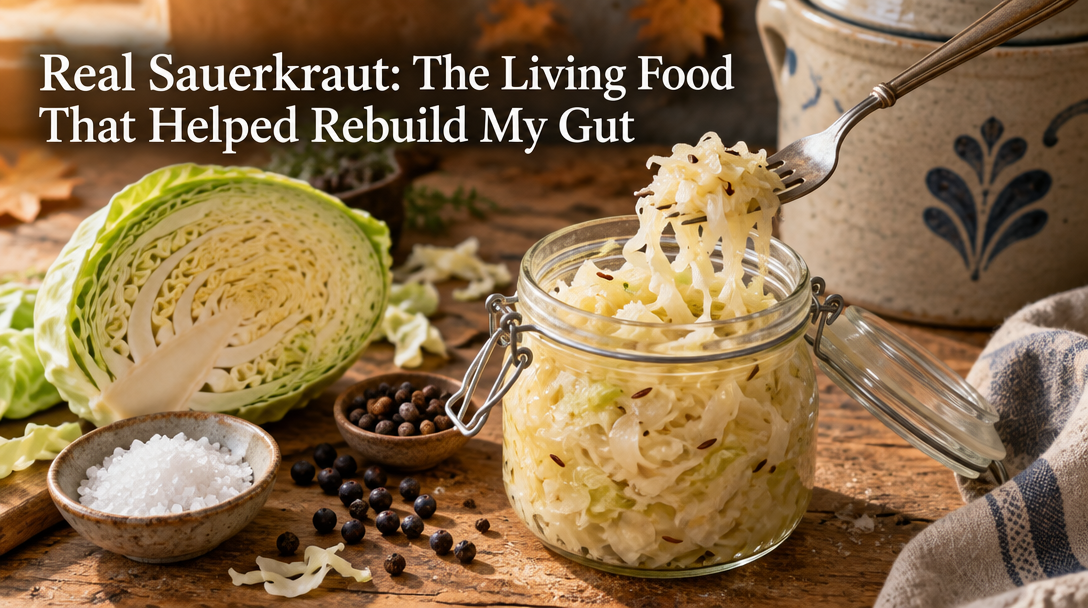
Real Sauerkraut: The Living Food That Helped Rebuild My Gut
A couple of months ago, I got backed up.
Not the usual kind where I take a couple of Klean Lax and I'm fine by morning. This was different. My bowels weren't moving, and pretty soon I wasn't just constipated — I was sick all over, the way you get when the trash isn't going out and the whole house starts to turn toxic. And my first move was exactly what it's always been: a couple of Klean Lax, fix it, ignore it, move on.
Except this time my body said, you've been ignoring this long enough.
It took almost a month to climb back out. And one of the things that turned it around wasn't a formula at all. It was a living food my wife Lynn put back on my plate — real sauerkraut. Not the stuff in a can on a shelf. The real, living, refrigerated kind. That's what this is about: why your gut is a living thing that needs feeding, the enormous difference between real sauerkraut and the imposter, and why this is exactly the season for it.

Food in Its Season
Here's a detail I love. Right now — September into October — is sauerkraut season.
In the Alsace, that stretch of land between Germany and France that has changed hands so many times it's practically its own country, the cabbage comes off the fields in early fall, and everyone makes their sauerkraut. I actually lived there for a time, and this is when it happens: the harvest comes in, and suddenly there's sauerkraut with everything. It's been that way for generations — not as a health trend, but as survival.
That's the heart of something Dr. James taught often: the body does best with food in its proper season. Nature tends to provide what we need when we need it. Sauerkraut was originally a way to take the fall cabbage harvest and preserve it as living, nourishing food to carry people through the winter — exactly when no fresh vegetables were available. It wasn't a trend. It was survival wisdom.
And it was medicine as much as food. In different villages, people would add different things to their kraut depending on what they needed or what was going around — juniper berries, pepper, various spices. Food and medicine in the same crock.
There's a great piece of history that proves how valuable this living food was: early sailors carried sauerkraut on long voyages and found they didn't get scurvy. We now know scurvy is a vitamin C deficiency, and sauerkraut is extremely high in vitamin C — high enough to keep sailors healthy on journeys where nothing fresh could survive. That's how it earned its place in winter survival wisdom.
Your Gut Is Alive — and It Needs Feeding
This ties straight back to the gut-immune episode we did a few weeks ago: so much of your health and immunity lives in your digestive tract, and the friendly flora — the good bacteria — run the whole show.
Sauerkraut is one of the most direct ways to actually feed and replenish those friendly flora. It has the probiotics in it, yes — but as Dr. James put it, it doesn't just feed the good flora, it replenishes it. If you're running low, it restocks the shelves. And here's the beautiful part: when your good flora is strong enough, it naturally crowds out the bad. A healthy population is made to run the system, not to be overrun. Bring the balance back, and the good bacteria do the rest.
So what actually is real sauerkraut? It's lacto-fermented. You take cabbage and salt, and the natural bacteria do the work — they transform the cabbage and create billions of living probiotic organisms along the way. The salt's whole job is to pull the moisture out of the cabbage; in doing that, it kills off the bacteria you don't want while the bacteria you do want thrives. That tangy sourness isn't vinegar. It's the signature of fermentation — proof the good bacteria are alive and present. You're eating a living food.
Lynn made a point worth repeating here: before she went back to sauerkraut, she'd been buying daily probiotic capsules, and they're expensive. Switching to real sauerkraut saved her a great deal of money — and her system runs better on it than it did on any of the bottles she tried. A jar of cabbage and salt outperforming a shelf of pricey capsules.
The Local-Bacteria Bonus
There's one more benefit to making your own — or buying local — that mirrors something you already know about honey. Local honey helps with allergies because the bees gathered pollen from the very plants around you that you react to. Sauerkraut works the same way: when it's fermented in your own kitchen or your own region, the bacteria are the ones living around you, so it helps build your body's familiarity with your local environment. Kraut shipped in from Germany is still delicious and still wonderful for you — there's just an added benefit to the batch fermented where you live.
What a Couple of Klean Lax Couldn't Fix
Here's the honest story, because it taught me something.
For years my pattern was simple: get a little constipated, throw a couple of Klean Lax at it, problem solved, ignore it, carry on. And Dr. James was always clear that Klean Lax is a temporary fix until you solve the real problem. It's wonderful when it's needed. But it doesn't rebuild anything. It's a band-aid — and I'd been slapping band-aids on the same spot for a long time without ever asking why the garbage trucks kept stalling.
Men are especially prone to this. You just keep going, day after day, because you don't get to sit down and actually take care of it. So things slow down, and they back up, and the problem builds quietly for years until one day it catches up with you all at once. That's where I was.
So this time we didn't chase the symptom. We rebuilt the system. It took a lot — more than fits in one article, and it looked specific to me — but the core of it was this:
- Real sauerkraut — to feed and replenish the good flora, plus the good fiber
- Col Cer — to rebuild the gut lining itself (Lynn's sister Jessica suggested 10 to 12 a day, and I did that for a couple of weeks while things repaired)
- Zime — taken before every meal, to prepare the stomach for digestion and supply the enzymes to actually break food down, since my system wasn't doing it well on its own
- Backing off a few foods — because when the system is down, things that are perfectly fine when you're healthy become too much for it to handle
- Manual therapy — one appointment with a skilled practitioner made a real difference (ours happens to be in Utah, so I can't point New Mexico folks to them — but it's worth knowing the modality exists)
Why Col Cer and Zime Aren't the Same Thing
People lump them together as "digestive formulas," but they do very different jobs. Zime is about digestion in the moment — take it before a meal and it preps your stomach and breaks the food down. Col Cer is about rebuilding the structure — it soothes, but it also heals the mucosal lining of the small and large intestines, giving that lining the nutrients it needs to keep things moving and to release the dry, stuck, rancid gunk that's been clinging to the walls. One helps you digest today; the other rebuilds the tract for the long haul.
And I'm still taking both — along with the sauerkraut, which I'd eat anyway because I genuinely love it — because the goal was never to patch it and walk away. It was to rebuild so this doesn't happen again. A lifetime habit of a living food like sauerkraut keeps giving the body what it needs so it supports and builds along the way, instead of waiting until everything's crashed and then scrambling to fix it.
That's the whole lesson. The band-aid approach works right up until it doesn't. Living this way — real food, rebuilding formulas, consistency — works with the body so it can do its own job again.
(An honest word: ongoing or severe digestive trouble is worth taking to your doctor. My story is my story; constipation can sometimes signal something that needs real medical attention.)
The Surprise I Wasn't Looking For
Here's something I did not expect.
For the last several years I've carried extra weight I simply could not get off. People told me it was just my build, my body type — but I'd tried diets, exercise, all sorts of things, and nothing moved it. And since I started eating sauerkraut, some of that excess weight has come off.
Now let me be crystal clear, because this matters: sauerkraut is not a weight-loss product. I'm not telling you to eat sauerkraut to lose weight, and I'm not promising it'll do for you what it did for me. Everybody's different. What I'm telling you is what happened, and why it makes sense.
It's not that the sauerkraut melts fat. It's that it helped me digest properly. And when you digest properly, your body can finally deal with all the sticky, hard, crusty, fermented yuck that's been sitting in your stomach and intestines — it can move it through, the way it's supposed to. When the system is genuinely working instead of just appearing to, good things follow. For me, one of those things was weight that had been stuck finally letting go.
There's a reason gut health and weight keep showing up together in the research right now. A well-functioning gut with a healthy bacterial population handles food differently than a sluggish, depleted one. No promises — but it fits everything Dr. James taught: get the foundation healthy, and good things tend to follow.
How to Buy the Real Thing (This Is Where People Go Wrong)
This is the part everyone needs to hear, because it's the easiest place to waste your money on something that does nothing.
When Lynn first sent me to the store for sauerkraut, I went up and down the canned-vegetable aisle looking for it. Cans, bottles, plenty of sauerkraut on the shelf. I finally had to ask someone — and it turns out the real stuff was in the refrigerated section the whole time. That's the single biggest tell.
Here's your checklist:
- It's in the refrigerated section — never shelf-stable. Shelf-stable means pasteurized, and pasteurizing kills the living bacteria that are the entire point.
- The label says cabbage and salt. That's it. Maybe a few spices — juniper berries, pepper, that kind of thing. Nothing more.
- No vinegar. If vinegar is in the ingredients, the sourness is fake — it was added, not fermented — and it's not what you want.
- If it's warm on a regular shelf, the good bacteria are gone. Cabbage soaked in vinegar is still fine to eat, it's just not doing the living-food job we're talking about.
One important note on why this is: I can make my own sauerkraut at home, seal it, and keep it shelf-stable and healthy. But stores aren't legally allowed to sell it that way — they have to pasteurize it to put it on a regular shelf. That's exactly why the real, living product lives in the fridge.
The Brands We Trust
Lynn's friend — who's old, wise, and has been doing this for decades — pointed her to Bubbies, and it's become our favorite. It comes in glass, it's in the refrigerated section, and it's remarkably consistent batch to batch (her friend swears the glass is why she's never gotten a bad jar). In New Mexico we find it at Sprouts and Smith's, and Natural Grocers likely carries it; it's a big national brand, so most natural-leaning stores across the country should have it.
When I need it in bulk, we get Wild Brine from Costco — also refrigerated, in a square container, and a genuinely good brand. The Costco size is big, though, so if you're only feeding one or two people, the smaller Bubbies jar is easier to get through before it's been open too long.
One safety habit with any fermented food: learn its normal smell, and if a jar ever smells unusually funky or off, don't eat it — just get a fresh one. You won't always know what stray bacteria found their way in, so when in doubt, toss it.
Start Small, Be Consistent
Two practical rules will save you some grief.
Start small. If you haven't been eating fermented food, begin with a tablespoon, not a cup. Introducing all those live probiotics can change your digestion — which may mean more bathroom trips, or a little gas and bloating at first. That's actually a good sign: it's often the bad bacteria dying off. But go slow, because if your system is already sluggish and you dump a whole cup in on day one, you can create more of a backup before things improve. A tip: start on a weekend, not a Monday, so your body has room to adjust. (For the record, Lynn does a careful tablespoon a day; I eat it by the cupful and put it on everything — but I'm the one who loves the stuff. She thinks the volume is part of why I bounced back as fast as I did, given how far down I was.)
Then be consistent. This is the thing we most want you to remember. It's consistency over time that builds the benefits. Eat it once a month and you'll get nothing we've been talking about. Have a little every single day and it's in your system constantly — sweeping, cleaning, building, regenerating. So pick the amount you can actually sustain: if a tablespoon a day is what you'll stick with, do a tablespoon a day, every day. Consistency beats intensity, every time.
Ways to Actually Eat It
You don't have to love it straight from the jar (though some of us do):
- On a bratwurst, a hot dog, or a good hand-packed sausage — the classic pairing (just watch what's in your hot dogs)
- On a burger, if that's your thing
- My own breakfast: grated potatoes, sauerkraut, a couple of eggs on top, and green chile, because we're in New Mexico. Lynn does hers over fried sweet potatoes too
- Stirred into soups, sauces, or salad dressings — but here's the key: add it at the very end, right before it hits the table. Never cook it into the dish, or you'll cook off the very bacteria you're after.
- And if you truly can't get past the smell, put a little on a spoon, plug your nose, and take it like a capsule. We've got a kid in our house who treats good coconut oil like "medicine" and refuses to let it touch his food — if that's you with sauerkraut, just take it separately. The benefits don't care how it gets in.
Food in Season, a Living Gut, Working With the Body
That's really the whole thing. I like the shortcut — two pills and all better — but that's not where I was, and trying to shortcut it is what kept me stuck. Adding a living food back into my diet made a genuine difference, and it reminded me how far we've drifted from living food in general. It happened so gradually that most of us never noticed how much we'd lost. Getting even a little of it back is a quietly powerful thing.
And the timing couldn't be better. Right now is the season — the cabbage is in, the tradition is alive across the ocean, and heading into winter, sauerkraut builds your vitamin C, prepares your gut, and supports your immune system against the colds, flu, and seasonal things coming your way. Food and formulas work together here: sauerkraut feeds the flora, Col Cer rebuilds the tract, Zime helps you break food down, and Fection supports the immune side without wrecking the gut.
The best part? This isn't something you have to buy from us. Make it yourself with a head of cabbage, some salt, and a clean jar, or pick up a good brand from the fridge. Either way, your body gets to go from just surviving to actually thriving.
If you want to support the rebuild from the inside, Col Cer, Zime, and Fection are at drugfreehelpstore.com. Questions about your own digestion — call us at 888-388-4413. And go find yourself some real sauerkraut.
Frequently Asked Questions
What makes real sauerkraut different from the kind on the shelf?
Real sauerkraut is lacto-fermented from just cabbage and salt, and it's full of living probiotic bacteria — which is the entire point. It's always found in the refrigerated section. Shelf-stable sauerkraut in cans or jars has been pasteurized, which kills those living bacteria, and its sourness often comes from added vinegar rather than fermentation. Cabbage soaked in vinegar is still fine to eat, but it doesn't deliver the gut-flora benefits of the living, refrigerated version.
How does sauerkraut help gut health?
Real sauerkraut delivers living probiotic bacteria that feed and replenish the beneficial flora in your digestive tract. A healthy population of good bacteria helps crowd out harmful bacteria, keeps things moving, and supports both digestion and immunity, since much of the immune system is associated with the gut. Because the good flora is naturally meant to run the system, restoring its balance helps the whole digestive process work better.
Can sauerkraut help with weight?
Sauerkraut is not a weight-loss product and shouldn't be eaten as one. What it can do is help you digest properly, and when digestion works well the body can move waste through as it should rather than letting it sit and accumulate. Gut health and weight are increasingly linked in current research, since a well-functioning gut handles food differently than a sluggish one. Results vary from person to person, and no outcome is promised.
How much sauerkraut should I eat, and how do I start?
Start small — a tablespoon rather than a cup — especially if you haven't eaten fermented foods before, because the live probiotics can change your digestion and cause temporary gas or more frequent bathroom trips as bad bacteria die off. Starting on a weekend gives your body room to adjust. Most important is consistency: a smaller amount every day does far more than a large serving once in a while, so choose a portion you can sustain daily.
What brands of real sauerkraut are good?
Bubbies is a widely available, consistent brand that comes in glass and is found in the refrigerated section at stores like Sprouts, Smith's, and many natural grocers. Wild Brine, available at Costco in a refrigerated square container, is another good option, though the larger size suits bigger households. Whatever the brand, confirm it's refrigerated, lists only cabbage, salt, and perhaps a few spices, and contains no vinegar.
Should I cook sauerkraut into my food?
No. Heat kills the living bacteria that make sauerkraut beneficial. If you're adding it to a soup, sauce, or cooked dish, stir it in at the very end, right before serving, rather than cooking it into the dish. You can also eat it cold on sausages, burgers, eggs, or potatoes, or blend it into dressings — just keep it away from heat.
Jim and Lynn Applegate host the Reality of Herbal Therapy podcast. Lynn is the daughter of Dr. Michael James, founder of Professional Herbal Instruction and Dr. James' Herbal Formulas. The experiences and formulas in this article come from the family's own use and Dr. James's clinical work.
This information is offered for educational purposes and is not intended to diagnose, treat, cure, or prevent any disease. These statements have not been evaluated by the Food and Drug Administration. For ongoing or serious digestive concerns, work with your own healthcare provider.
Professional Herbal Instruction | DrugFreeHelpStore.com | 888-388-4413
![[Podcast] Fermented Survival Wisdom — From Alsace to Your Microbiome](http://www.drugfreehelpstore.com/cdn/shop/articles/Sauerkraut.png?v=1790975304&width=816)
