Article: Liv Clean and the Liver: Why the Body's Filter Needs Rinsing Too
Liv Clean and the Liver: Why the Body's Filter Needs Rinsing Too
Dr. Michael James used to ask people whether they would wash dishes with a rag they never rinsed out. Most people answered quickly, and then sat with what it implied. The liver is the big dish rag of the body — and the body cannot be any cleaner than the liver itself.
That line is the one people remember. But there is a second half to his teaching on the liver that almost nobody has heard, and it runs directly against forty years of dietary advice.
The liver does not run on nothing. It is an organ doing continuous work, and work requires fuel. The fuel the liver uses is oil — which is exactly what most people spent four decades being told to take out of their diet.

What does the liver actually do?
The liver filters the blood, processes what you eat, breathe and absorb through your skin, and produces bile. Bile does two jobs at once: it emulsifies fat so it can be digested, and it carries processed material out of the body. That makes the liver both a filter and a working part of digestion.
Those two roles are the reason the liver belongs in a digestive conversation rather than sitting off by itself. Every time you eat a meal containing fat, you are asking the liver for bile. Every time your body processes something it needs to get rid of, you are asking the liver for the same fluid. One organ, two demands, same output.
The dish rag, and the part people miss
Everybody gets the first half of the analogy. The rag that cleans everything else has to be kept clean itself, or you are just moving dirt around.
Here is the half that gets missed. A dish rag is passive — it does not need feeding. The liver is not a rag. It is a working organ running an enormous amount of chemistry every hour of your life, and it has a fuel requirement the same as any muscle.
The liver will clean and detoxify the body, but the body can't be any cleaner than the liver itself.
So there are two separate questions, and people only ever ask the first one. Is my liver carrying too much? And: is my liver getting what it needs to do the work?
Why the liver runs on oil
This is the part of Dr. James's teaching that surprises people, and it is the most useful thing in this article.
The liver uses fat as fuel. He called it the liver's gasoline. Given a good supply of good oil, it functions the way it is supposed to.
Now consider what happens when the supply is not there. The liver still needs fuel, so it makes its own — converting protein and carbohydrate into fat to run on. Dr. James's observation was that the manufacturing process is wasteful. By the time the liver has produced enough fuel for itself that way, a good deal of surplus has been made along the road, and it does not stay in the liver.
Which is a strange thing to sit with, given what the last several decades of food marketing told everybody. Dr. James considered fat-free diets a misconception, and he was saying so when it was an unpopular position.
What counts as good oil
Dr. James drew the line at processing method rather than at the plant it came from, and it is a practical distinction you can use in a grocery aisle.
| Look for | What it means |
|---|---|
| Cold pressed | The oil was pressed out mechanically without added heat, so the oil arrives closer to how it was in the seed or fruit. |
| Expeller processed | Also mechanical pressing, under pressure. Some heat is generated by friction, but no chemical solvent is used. |
Most oil on a supermarket shelf is neither. It is extracted with solvents and refined heavily, because that is cheaper and produces more oil per seed. If a label says nothing about how the oil was pressed, that silence is usually the answer.
This connects back to something covered in the fiber article: Dr. James taught diet in four elements — water, starch, protein and fat — rather than food groups. Oil was one of the four, not a thing to be eliminated.
Dr. James's own recommendation was extra virgin cold pressed coconut oil, and he was specific about the amount: three tablespoons a day. The point was not the calories. It was that the liver needs fuel to do its work, and he wanted enough of it getting there consistently. Coconut oil is a particularly direct way to supply that, because it is made largely of medium-chain fats. Most dietary fat is long-chain, which the body packages up and routes through the lymphatic system before it ever reaches the liver. Medium-chain fats take a shorter road — absorbed and carried by the portal vein straight to the liver. That makes coconut oil close to a direct delivery, which is exactly what you want when the goal is fueling the organ rather than feeding the body generally. It is also cold pressed by definition in its virgin form and stable enough to cook with at temperatures that damage more delicate oils. Three tablespoons is a real amount, so work up to it gradually rather than starting there — a sudden jump in fat gives most people digestive trouble. And if you are managing cholesterol or have been told to limit saturated fat, make that a conversation with your doctor before it becomes a change in your kitchen.
Related: Fiber, Bulk and Regularity — What Kolonic Kaps and Klean Lax Each Do
What is in Liv Clean
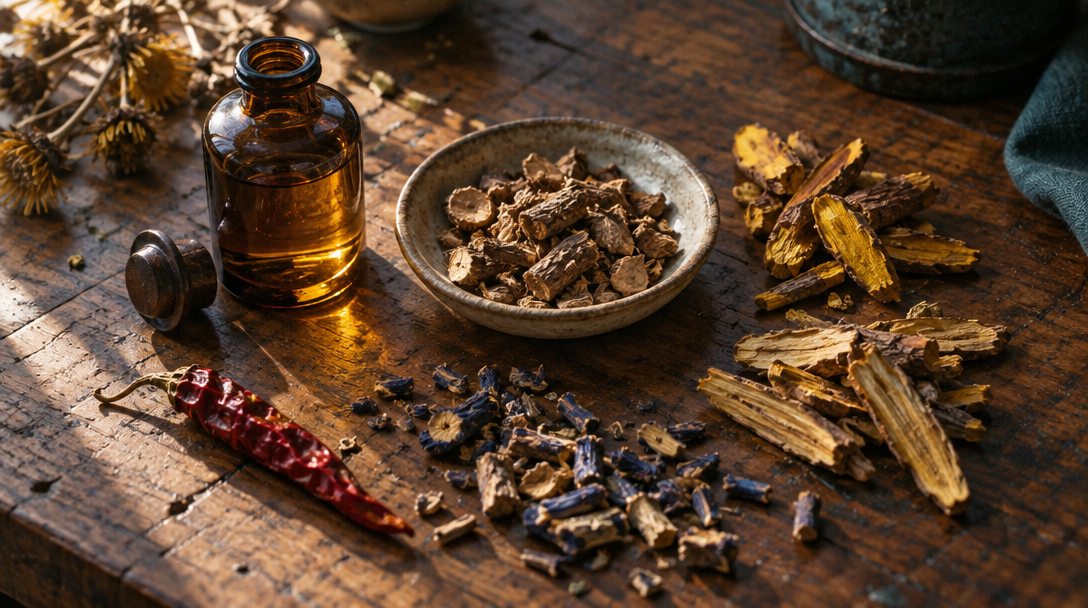
Liv Clean was formulated to support the organ in the work it already does. The traditional uses of its contents sit almost entirely around bile and the organs that handle it:
- Barberry root has been used for its positive influence on the bile duct, liver and kidneys.
- Gentian root has been used as a tonic for the liver and gallbladder, to liquefy and promote bile flow.
- Dandelion root has been used to provide cleansing of the liver, pancreas, gallbladder and spleen.
- Cayenne has been used to stimulate digestive secretions and the related cleansing processes of the body.
- Goldenseal root has been used as a liver tonic.
- Oregon grape root has been used to stimulate saliva and bile secretions.
Read that list and the design is visible. Four of the six are working on bile — producing it, thinning it, keeping it moving. That is not a coincidence. Bile is the liver's outbound route, and a route that is not flowing freely is the most common place for the whole system to back up.
Typical amounts are 1 capsule daily for general support, 3 for moderate, and 6 where more is wanted. At 665 mg per capsule it is one of the simpler commitments on our shelf.
Who should talk to a doctor first. Liv Clean contains barberry, goldenseal and Oregon grape. These are traditional bitter herbs with a long history of use, and they are also herbs that can interact with medication. If you are pregnant or nursing, taking any prescription, or managing a liver or gallbladder condition — particularly gallstones — speak with your doctor or pharmacist before starting, and call us at 888-388-4413 so we can talk it through with you.
The liver and the skin
One more connection, and it is the reason this article sits where it does in our October series.
The liver is not the body's only route out. Skin is another. When the liver is carrying a heavy load, more of the work shifts to the other routes available — and skin is the one you can see.
Dr. James noted across his years in practice that cleansing the body tended to show up in the skin. We put it no stronger than he did, and we are careful not to turn an observation into a promise. But it is the reason we do not treat skin as a separate department, and it is where our November articles pick up.
Where the liver fits in your picture
- If fatty and fried meals hit you harder than anything else, that is a bile signal more than an enzyme one. Bile is the liver's department.
- If the trouble shows up hours after a meal rather than within the first hour, the same applies. Enzyme shortfalls tend to announce themselves sooner.
- If you have spent years on a low-fat or fat-free diet, the fuel question is worth asking regardless of symptoms.
- If you are generally short on energy and nothing obvious explains it, the liver is a reasonable place to look — though it is far from the only one, and persistent fatigue is worth taking to a professional.
- Start by changing the oil in your diet before you change anything else. Cold pressed or expeller processed, in reasonable amounts, consistently. That costs you nothing but attention at the grocery store. Dr James always preferred extra virgin cold pressed coconut oil.
- Give it time. This is support for an organ, not a switch being flipped. Weeks rather than days.
Related: Zime and Col Cer — Two Formulas, Two Completely Different Jobs
Common questions
Can I take Liv Clean alongside the other digestive formulas?
Yes. Liv Clean, Zime and Col Cer work on different parts of the picture and plenty of people use more than one. Follow the amounts for each separately rather than averaging them.
Is a low-fat diet bad for the liver?
Dr. James's position was that the liver needs fat as fuel and that cutting it out entirely works against the organ. His emphasis was on quality — cold pressed or expeller processed oil, in sensible amounts — not on eating more fat generally. If you are on a fat-restricted diet for a medical reason, that is a conversation for you and your doctor rather than something to change on your own.
How long does Liv Clean take to notice?
Longer than a digestive aid tied to meals. This is organ support, and the honest expectation is weeks.
Do I need a "cleanse" or is daily support enough?
For most people asking the question, consistent daily support plus better oil in the diet does more than a short intensive push. If you want to talk about a more structured approach, call us — that is a conversation rather than an article.
Not sure whether the liver is your piece of this?
Call 888-388-4413 and describe what is happening — what kind of meals give you trouble, how long after eating, and what your oils look like at home. Bile-side and enzyme-side problems sort out quickly in conversation and are hard to tell apart on your own.
Jim Applegate owns Professional Herbal Instruction and DrugFreeHelpStore.com, the home of Dr. Michael James's herbal formulas. He took over the family company after twenty-five years in business and handles everything from the formulas on the shelf to the phone line customers call. He co-hosts The Reality of Herbal Therapy podcast with his wife Lynn.
Professional Herbal Instruction · drugfreehelpstore.com · 888-388-4413
These statements have not been evaluated by the Food and Drug Administration. These products are not intended to diagnose, treat, cure, or prevent any disease. This article is educational and is not a substitute for care from a qualified healthcare professional. If you are pregnant, nursing, taking medication, or managing a health condition, speak with your doctor before use. If symptoms are severe, worsening, or persistent, please see a doctor.