The Seed Oil Hiding in Your Vitamins: Why We Chose Olive Oil for Our Vitamin D
You cleaned out the kitchen. You tossed the canola, switched to olive oil, started reading labels at the store. And then every morning you reach into the cabinet and take a vitamin D softgel floating in sunflower oil.
Last week on The Reality of Herbal Therapy, nutritionist Cherie Calbom — "The Juice Lady" — walked us through why seed oils don't belong in your diet and why the fruit oils (olive, avocado, coconut) are the ones worth trusting. That conversation stirred up something we'd been meaning to talk about for a long time, because there's one place almost everyone is still swallowing seed oils without realizing it: their vitamins.
This week, Jim and Lynn go after that hidden spot — and share why we've finally brought our Vitamin D3 back, made the way Dr. James always insisted on: in olive oil, not seed oil.

The One Cabinet Nobody Thinks to Check
Here's the recap for anyone who missed last week. Seed oils — canola, soybean, sunflower, safflower, grapeseed — started life closer to industrial products than food. Their processing leans on high heat, bleaching, and chemical agents, and they were rebranded "vegetable oils" and sold as heart-healthy on a foundation that, as Cherie laid out, doesn't hold up well.
The antidote is the fruit oils: olive, avocado, and coconut — pressed from the flesh of a fruit, minimally processed, the fats people have trusted for thousands of years. Look for virgin or extra virgin, where the processing is gentlest.
Cherie's loudest piece of advice was simple: read your labels. And that's exactly what Dr. James drummed into people for decades too. But most of us only think to read labels on food. The vitamin cabinet gets a pass — and that's the blind spot.
Why Vitamin D Has to Come in an Oil at All
Why is vitamin D always suspended in oil instead of sold as a plain pill or powder?
Because vitamin D is a fat-soluble vitamin — it has to be dissolved in a fat for your body to absorb and carry it. It physically cannot do its job as a dry powder with nothing to carry it.
There are two broad kinds of vitamins, and the difference is everything here:
- Water-soluble vitamins (like the B vitamins) dissolve in water. Take a big dose of B and your urine turns bright yellow — that's your body flushing out what it couldn't use through the kidneys.
- Fat-soluble vitamins (A, D, E, and K) need fat to be absorbed. Your body holds onto them rather than flushing them, and without a fat to carry them, they don't get where they need to go.
Dr. James used to explain it with milk: you need roughly 3–5% milk fat for your body to actually pull the vitamin D out of it. Less fat than that, and the vitamin D is along for the ride but can't be absorbed. That's the whole reason a vitamin D softgel comes floating in oil in the first place.
Which raises the question nobody asks at the store: the oil is there on purpose — but which oil did they use?
What You'll Find When You Turn the Bottle Over
Turn almost any vitamin D bottle over, skip past the vitamin itself, and read down to the "other ingredients" line. Over and over, you'll find the carrier oil listed there: sunflower oil, safflower oil, canola (rapeseed) oil. The exact seed oils you've been working to get out of your kitchen.
Right after last week's episode, Lynn went to a local store and checked every vitamin D on the shelf. The result: zero that weren't carried in a seed oil. Not one. The big-box membership stores were no better — she's never found a large bottle there carried in a decent oil, and the same goes for vitamin E and the other oil-based vitamins. Online you can finally find a few good brands, but it takes digging, and if you live in a small town you may never find one on a shelf at all.
The irony writes itself. You can do everything right at the dinner table and still take a daily dose of the very oil you're avoiding — in the vitamin you bought to be healthier.
Two things to check on any oil-based vitamin
- The carrier oil. Stick to coconut, olive, or avocado oil, and look for virgin or extra virgin.
- The expiration date. This one matters far more than with our herbal formulas. Fruit oils aren't ultra-processed for a decade-long shelf life, so they can go rancid — and rancid oil is genuinely bad for you. A huge warehouse bottle is no bargain if you're still working through it a year past its date. (Our dried, encapsulated herbs in sealed dark bottles last a very long time; oil-based vitamins are a different story and need fresh dates and a cool, dark place.)
That shelf-life difference, by the way, is part of why so many brands reach for seed oils: the heavy processing makes them shelf-stable for years. But stable on a shelf and good for your body are not the same thing. As Jim put it: if the bugs can't process it, neither can you.
What Vitamin D Actually Does for You
So why take it at all? Vitamin D earns its place, and not only for the reason most people assume.
It supports healthy bones — and it's the reason your calcium works. Most people hear "strong bones" and think calcium. But your body can't absorb calcium without vitamin D. Check any calcium supplement: if it doesn't include vitamin D, your body simply can't put that calcium to use.
It supports immune function. This is why it matters most heading into the darker months, when you're getting less sun — more on that in a moment.
It supports mood and overall wellness. Lynn still remembers the years the family lived in Oregon: six to nine months of barely seeing the sun, mostly filtered through clouds. Everyone in the house — Jim, Lynn, the kids — needed more vitamin D just to feel emotionally steady through those long, gray winters. It's the same reason people in Oregon, Washington, and Alaska rely on sunlight lamps.
And here's the part that connects it all: your body makes vitamin D from sunlight. The sun converts the cholesterol in your skin into vitamin D, which your body then absorbs. That's why people tend to get sicker in winter — less skin in the sun means less vitamin D being made, right when immune support matters most. Supplementing simply fills the gap the season left.
Worth knowing: being outdoors isn't always enough. We know of someone who practically lived outside on a farm and still tested deficient — once they started supplementing, their energy came back. Everyone's body processes it a little differently.
Dr. James's Cold-and-Flu-Season Boost
Can you take extra vitamin D when you feel something coming on?
This is something Dr. James taught often in his seminars. When flu season was setting in — or at the first sign of "the crud" — he would have people take a larger dose for two days in a row to give the immune system a boost, rather than waiting for their body to slowly catch up to the season.
The idea is that a short, higher-dose boost helps kickstart the immune system right when it's up against everything going around. In the Applegate house, they'll do that two-day boost at the predictable danger points — the start of school, say, when everyone's about to be packed in together — alongside the other things they lean on, like Fection, to give their bodies a fighting chance.
A few honest cautions, because this is the part to get right:
- This is a short-term boost, not a new everyday habit. Vitamin D is fat-soluble, which means your body stores it and it can build up — so more is not simply better.
- The right amount depends on the person — body weight and circumstances matter — so this isn't a one-size number to broadcast. Dr. James had a specific way he scaled it, and the right move is to talk with us or with your healthcare provider for what fits you, rather than guessing.
- Check with your provider first if you are pregnant, nursing, or taking medication.
If you want to know how Dr. James approached the dosing, give us a call — that's a conversation worth having one-on-one.
Why Olive Oil, and Why Now
Our Vitamin D3 is back, and here's exactly what it is:
- Vitamin D3 (cholecalciferol) — the natural, usable form your body makes from sunlight. (Skip the synthetic versions; look for the naturally-occurring form, often sourced from lanolin.)
- 5,000 IU — the typical daily amount for an adult, one softgel a day.
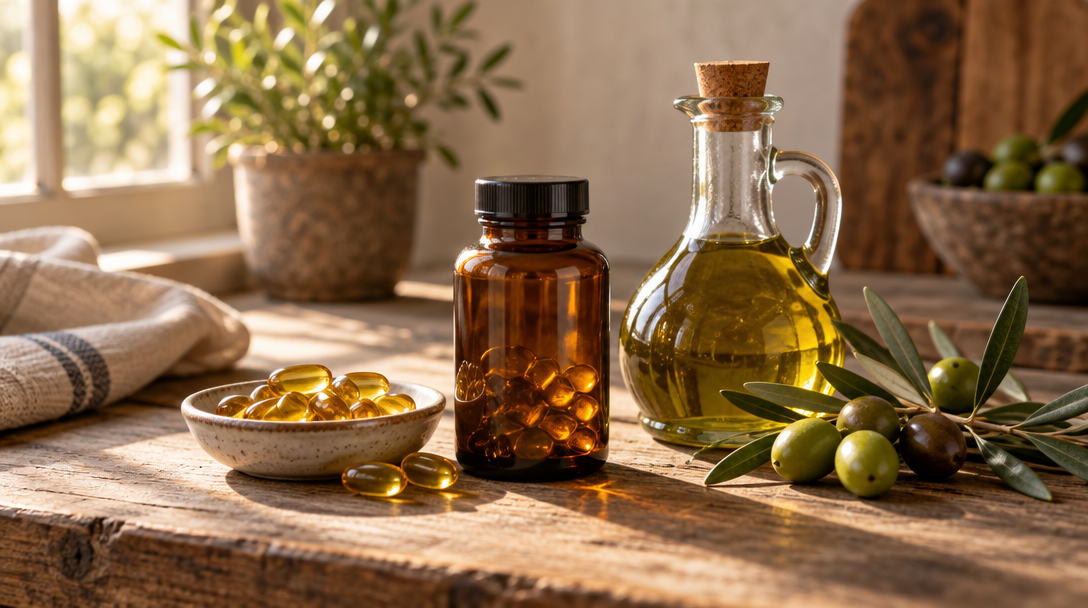
- Carried in extra virgin olive oil — a fruit oil, not a seed oil.
Why olive oil specifically? Beyond being the fruit oil we championed last week, it carries a long reputation for health and vitality. It's the staple of the Mediterranean where it's been part of daily life for millennia — and Dr. James and Veronica taught, over and over, that when something has been used safely for thousands of years and people stayed healthy on it, you can trust it far more than a new, heavily-processed fad that hasn't been tested by time.
That's really the whole philosophy in one bottle. If we're going to tell you to get seed oils out of your kitchen, we're not going to hand you one in a vitamin.
The One-Sentence Takeaway
The oil carrying your vitamin matters just as much as the oil carrying your food. So read that label too — all the way down to "other ingredients" — and check the date while you're at it.
Every small choice adds up, because your body is always rebuilding itself. Some cells turn over in a day or two; your skin renews about every week; other tissues take years. You're never too old to make a good change — you're just feeding the next version of yourself something better, one day at a time.
Frequently Asked Questions
Why is vitamin D always in oil instead of a powder or plain pill? Vitamin D is a fat-soluble vitamin, which means it must be dissolved in a fat for your body to absorb it. Without an oil to carry it, your body can't put it to use — so softgels suspend the vitamin in oil by design.
What carrier oils should I avoid in a vitamin D supplement? Avoid seed oils: sunflower, safflower, canola (rapeseed), soybean, and grapeseed. These are the same heavily-processed oils many people work to remove from their diet, and they frequently show up in the "other ingredients" line of vitamin D bottles.
Which carrier oils are better? Look for a fruit oil — olive oil, avocado oil, or coconut oil — ideally virgin or extra virgin. Our Vitamin D3 uses extra virgin olive oil.
Why does the expiration date matter so much on an oil-based vitamin? Fruit oils aren't ultra-processed for a long shelf life the way seed oils are, so they can go rancid over time, and rancid oil is bad for your body. Buy a size you'll finish while it's fresh, and store it in a cool, dark place.
What does vitamin D do in the body? Vitamin D supports healthy bones — it's actually required for your body to absorb calcium — and it supports immune function, mood, and overall wellness, especially during darker months when you're getting less sunlight.
Why does Dr. James recommend olive oil specifically? Olive oil is a fruit oil with a long history of supporting health and vitality, a staple of the Mediterranean diet used safely for thousands of years. Dr. James and Veronica taught trusting time-tested foods over newer, heavily-processed alternatives.
Ready to make the switch? Our Vitamin D3 5000 IU in extra virgin olive oil is now available at drugfreehelpstore.com. Have questions, or want to ask about Dr. James's seasonal immune-boost approach? Call us at 888-388-4413 — we'd love to talk it through with you.
And if you missed last week's conversation with Cherie Calbom on seed oils and fruit oils, go back and give it a listen — it's the foundation this whole discussion is built on.
These statements have not been evaluated by the Food and Drug Administration. This content is for educational purposes only and is not intended to diagnose, treat, cure, or prevent any disease. Always consult a qualified healthcare provider before making changes to your health routine, especially if you have a medical condition, take medication, or are pregnant or nursing.