The Digestive System: Your Body's First Line of Defense

Estimated read time: 9 minutes
In this guide:
- What Most People Get Wrong About the Digestive System
- How a Damaged Gut Creates Problems Elsewhere in the Body
- The Colon: The Digestive System's Most Overlooked Organ
- The pH Problem: How Modern Diet Turns the Gut Against Itself
- Col Cer: Soothing the Digestive Tract from Mouth to Intestine
- Kolonic Kaps: Rebuilding the Colon from the Inside Out
- Klean Lax: When the System Needs a Reset
- Dr. James' Protocol: A Practical Path Forward
- Frequently Asked Questions
The Gut Doesn't Just Digest Food. It Decides What Heals.
There is something your doctor almost certainly never told you — and it is not because they are hiding it. It is because modern medicine is organized by specialties. Cardiologists own the heart. Neurologists own the brain. Gastroenterologists own the gut. And almost no one in that system asks the question that Dr. James spent decades asking in his clinical practice:
What if the problem in the organ you are treating started somewhere else?
Dad used to say you cannot heal anything until the colon is clean.
It sounds simple. It sounds almost too simple. But the more you understand how the digestive system actually works — not just how it processes food, but how it communicates with every other system in the body — the more that sentence becomes one of the most profound things a clinician can say.
This guide covers what the digestive system is actually doing, why a compromised gut creates symptoms that appear to have nothing to do with digestion, and what herbal support can do to help the body rebuild what modern life has damaged.
What Most People Get Wrong About the Digestive System
Most people understand the digestive system in terms of mechanics. Food goes in. Nutrients get absorbed. Waste comes out. When something goes wrong, you reach for an antacid, a stool softener, or an over-the-counter remedy and move on.
That mechanical model misses almost everything that matters.
The digestive system is approximately 30 feet of mucous membrane — from the mouth through the esophagus, stomach, small intestine, and large intestine — and it does not simply break down food. It is the body's primary interface with the outside world. Everything you ingest — food, water, medications, environmental contaminants, stress hormones — passes through it. The digestive tract decides what gets let in and what gets kept out.
When that interface is damaged or inflamed, the decision-making breaks down. Nutrients that should be absorbed are not. Toxins that should be eliminated are reabsorbed. Beneficial intestinal flora — the microbiome that regulates immunity, mood, inflammation, and dozens of other functions — loses its foothold. The whole downstream system begins to suffer.
The pattern Dr. James observed most often in his practice was this: people came in with a specific complaint, and the root of it was almost always in the digestive tract. Blood pressure issues, skin conditions, chronic fatigue, pain, mood imbalances — he traced them back to a gut that was overwhelmed, inflamed, or blocked, long before the secondary symptom had a name.
This is not alternative medicine. This is anatomy.
How a Damaged Gut Creates Problems Everywhere Else
The gut is not isolated from the rest of your body. It is directly wired into it.
The gut-immune connection is the most well-established. Approximately 70 percent of the immune system's tissue is located along the digestive tract — a network called gut-associated lymphoid tissue (GALT). This tissue monitors everything passing through the intestinal walls, identifying threats and launching immune responses. When the gut lining is chronically inflamed or damaged, that monitoring system becomes dysregulated. The immune system either over-responds (as in autoimmune conditions) or under-responds (as in persistent infections), depending on the individual.
The gut-brain connection is equally significant. The enteric nervous system — sometimes called the "second brain" — contains more nerve cells than the spinal cord and communicates directly with the central nervous system via the vagus nerve. Serotonin, the neurotransmitter most associated with mood and wellbeing, is produced primarily in the gut. Disruption to the gut lining and microbiome is directly associated with disruptions in cognitive function, emotional regulation, and sleep quality.
The gut-skin connection follows the same logic. The skin is an organ of elimination. When the digestive tract is backed up or overwhelmed, the body attempts to eliminate toxins through other pathways — including the skin. Chronic skin conditions — eczema, acne, rashes, unexplained breakouts — are frequently downstream expressions of a digestive system that is not clearing effectively.
The gut-liver connection closes the loop. The liver is the body's primary filtration organ, and it filters everything the gut absorbs. When the digestive tract is permeable, inflamed, or loaded with unprocessed waste, the liver receives an elevated toxic burden. Over time, that burden compromises liver function — which then compromises the entire detoxification cascade.
This is why Dr. James always started with the digestive system. Not because the gut was always the presenting complaint, but because the gut was almost always the origin of the presenting complaint.
The Colon: The Digestive System's Most Overlooked Organ
Of all the structures in the digestive tract, the large intestine — the colon — carries the most clinical weight in Dr. James' framework, and it is the most neglected in conventional care.
The colon's job is to receive the waste material that has passed through the small intestine, extract remaining water and minerals, compact it, and move it out of the body efficiently. It also houses the largest concentration of microbiome bacteria anywhere in the body — trillions of organisms that produce nutrients, regulate inflammation, and protect the gut wall.
When the colon is sluggish, backed up, or chronically irritated, none of that works correctly.
Transit time is the first indicator. Healthy transit time — the period from eating a meal to complete elimination — should be approximately 12 to 24 hours. Most Americans run significantly longer than that. The longer waste material sits in the colon, the more opportunity there is for bacterial imbalance, reabsorption of waste products, and chronic low-grade inflammation throughout the bowel wall.
Colitis, diverticulosis, irritable bowel syndrome, spastic colon, hemorrhoids — these are not separate diseases in Dr. James' view. They are different names for a colon under different degrees of stress. The mechanism is the same: an irritated, inflamed, or insufficiently supported digestive membrane trying to do its job without the nutritional resources it needs.
Refined carbohydrates are the primary driver. Today's standard diet — high in processed grains, sugars, and shelf-stable packaged foods — changes the pH of the digestive tract, shifting it toward acidity. That pH shift disrupts beneficial bacteria, irritates the mucous membrane lining the bowel, and sets the body in a state of chronic, low-level digestive distress. Over time, that distress compounds.
The good news is that the digestive tract — when properly supported — is extraordinarily capable of rebuilding itself. But it does not rebuild on antacids.
The pH Problem: How Modern Diet Turns the Gut Against Itself
This is the mechanism most people have never heard explained directly, and it is worth understanding clearly.
The digestive tract maintains a delicate pH balance — different sections of the tract require different levels of acidity and alkalinity to function. The stomach requires high acidity to activate digestive enzymes and break down proteins. The small intestine requires a more alkaline environment for nutrient absorption. The colon requires a slightly acidic environment that favors beneficial bacteria.
When refined carbohydrates dominate the diet, the entire system's pH shifts toward sustained acidity. The stomach overproduces acid. The intestinal environment becomes unfavorable for beneficial bacteria. The gut wall becomes irritated.
Here is the part that matters most: antacids make this worse, not better.
When you introduce an antacid, the body detects the pH disruption and responds by producing more acid in an attempt to restore its normal state. The drug suppresses a symptom. The underlying mechanism continues and intensifies. The patient takes more antacids. The cycle deepens.
Dr. James observed this in his own life. At 18, he was hospitalized with bleeding ulcers. The doctors — who he later said struck him as unusually honest — eventually did nothing, and he recovered on his own. After discharge, he was prescribed Valium. The pharmacist who filled the prescription looked at him with concern. That conversation was the beginning of a different approach to digestive health that would define the rest of his clinical career.
The alternative is not to suppress the symptom. It is to change the terrain.
That begins with diet. It continues with nutritional support that rebuilds the digestive membranes, restores normal function, and allows the colon to do what it was designed to do.
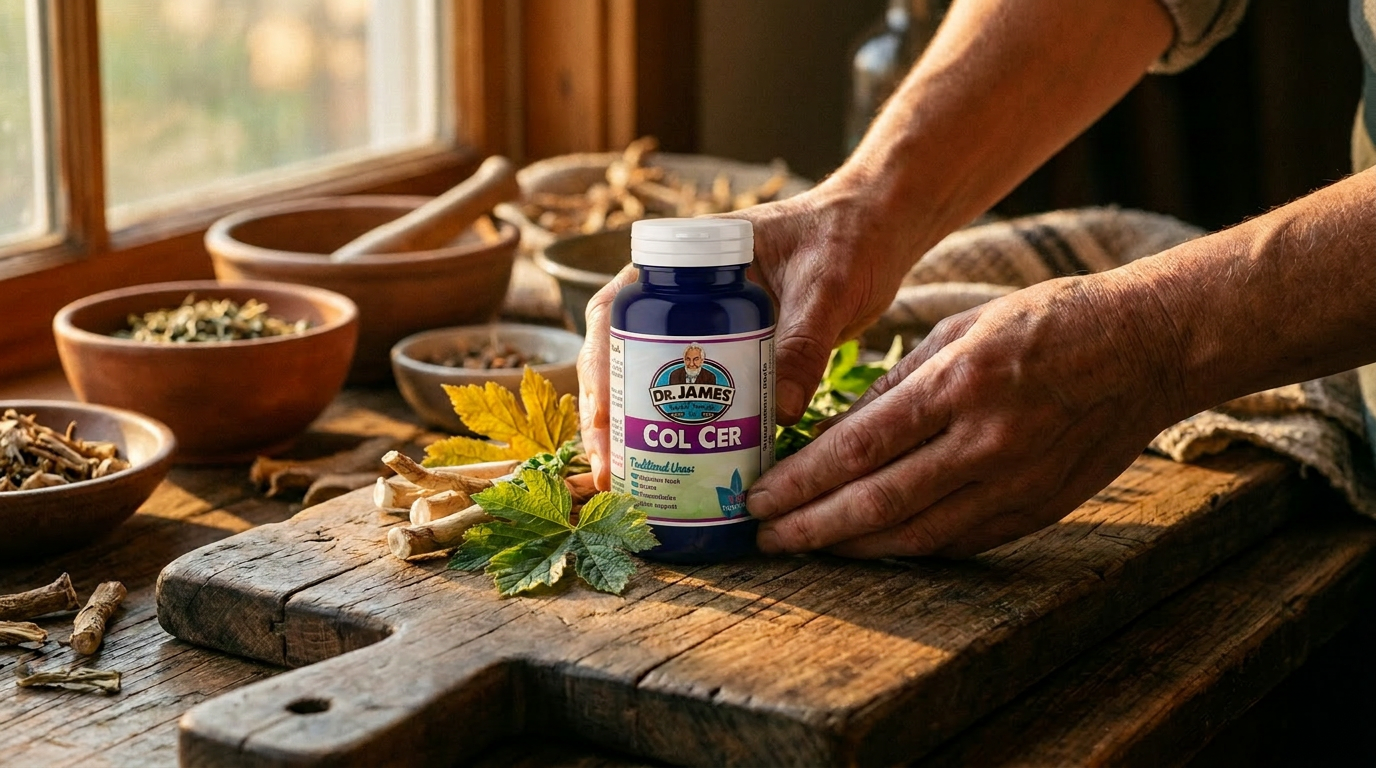
Col Cer: Soothing the Digestive Tract from Mouth to Intestine
Col Cer is the formula Dr. James developed specifically for digestive tract membrane support, and it is the one he reached for first in virtually any digestive protocol.
Its scope is broader than most people expect. Col Cer supports the entire digestive membrane — from the mouth and throat, through the stomach, small intestine, and large intestine. It is particularly indicated for colitis, ulcers, spastic colon, diverticulosis, hemorrhoids, and chronic digestive tract irritation. It has also been used as a mouth rinse for thrush in infants and for canker sores.
The botanical combination works through several mechanisms:
Goldenseal Root and Oregon Grape Root have a long history of use for ulcers and colitis. They support the growth of beneficial intestinal flora — the beneficial bacteria that the gut needs to maintain normal pH, produce nutrients, and protect the mucosal lining.
Myrrh has been used as an excellent tonic for sores, ulcers, colitis, and spastic colon. Its traditional use in wound care translates directly to the internal wound environment of an inflamed bowel.
Cranesbill Root has been used to soothe and tone the digestive tract — supporting the structural integrity of the mucosal membrane rather than simply calming surface irritation.
Marshmallow Root provides mucilaginous coating to the digestive membranes. It does not suppress symptoms — it physically protects and soothes the tissue while the body rebuilds.
One important note on expectations: rebuilding the digestive tract takes time. Dr. James was direct about this in his clinical teaching. You cannot expect one capsule to undo years of dietary damage. The digestive membrane requires sustained nutritional support — and it will respond, given that support, in ways that can reach far beyond what anyone expected from a "gut supplement."
Col Cer is available at drugfreehelpstore.com.
Kolonic Kaps: Rebuilding the Colon from the Inside Out
Kolonic Kaps addresses the colon from a different angle — not membrane repair, but bulk, tone, and detoxification.
The formula centers on a combination of dietary fibers and detoxifying agents that give the colon what modern diet consistently strips away: the material it needs to form healthy, regular, well-toned bowel movements and to carry waste effectively out of the body.
Psyllium Husk is the most well-studied colonic fiber available. Beyond bulk formation, it functions as a demulcent, expectorant, emollient, and astringent. It has been used in the management of chronic constipation, colitis, diarrhea, dysentery, irritable bowel syndrome, and elevated cholesterol. The range of conditions here is not coincidental — all of them trace back to a colon without adequate fiber to regulate its function.
Apple Fiber absorbs toxins in the digestive tract, including environmental toxins, and supports normalized cholesterol and blood-sugar levels. It promotes healthy blood pressure levels and is particularly valued for its ability to support cardiovascular markers through digestive health.
Oat Bran Fiber contributes to healthy lipid profiles and LDL regulation. It bulks the colon and promotes regular, healthy bowel movements — which is the most direct route to reducing the toxic burden on the liver and blood.
Grapefruit Fiber adds Vitamin C and beta-carotene (from the pink variety) and supports fat metabolism by pulling fat into the bloodstream where it can be burned for energy rather than stored.
Diatomaceous Earth detoxifies the colon and addresses intestinal parasites — an underacknowledged aspect of colon health, particularly in adults who have traveled or who have had prolonged digestive issues.
In Dr. James' protocols, Col Cer and Kolonic Kaps are frequently used together — Col Cer to address the membrane and flora, Kolonic Kaps to address the mechanical function of the colon and support elimination. They are complementary, not redundant.
Kolonic Kaps is available at drugfreehelpstore.com.
Klean Lax: When the System Needs a Reset
When the colon is significantly backed up — when transit time is prolonged, elimination is infrequent, and the body is clearly struggling to move waste — Klean Lax provides the direct support the system needs to reset.
Klean Lax is Dr. James' formula for sluggish bowel, used at bowel-tolerance dosing — meaning the dose is adjusted to the individual until normal, comfortable, regular elimination is achieved. This is not a harsh laxative in the conventional sense. It is nutritional support for a system that has lost its normal rhythm.
It pairs with both Col Cer and Kolonic Kaps as part of a complete digestive reset — Col Cer rebuilding the membranes, Kolonic Kaps restoring bulk and detoxification, and Klean Lax restoring regular movement when the system is too backed up to respond to fiber alone.
Klean Lax is available at drugfreehelpstore.com.
Dr. James' Protocol: A Practical Path Forward
This is the approach Dr. James taught, adapted for the context of anyone beginning to address their digestive health with nutritional support.
Step 1: Address the diet. Refined carbohydrates are the primary driver of pH disruption in the digestive tract. Reducing or eliminating processed grains and sugars is the first and most important step. No formula can fully compensate for a diet that continues to damage the terrain it is trying to rebuild.
Step 2: Start with colon support. Before addressing any other system — circulation, liver, hormones, immune function — ensure the colon is moving effectively. A backed-up colon means that everything else the body is trying to eliminate is being reabsorbed. Col Cer and Kolonic Kaps together provide the most complete starting point. Add Klean Lax at bowel tolerance if elimination is infrequent or sluggish.
Step 3: Be patient with the timeline. The digestive membrane does not rebuild overnight. Dr. James taught his patients to expect a process, not a moment. Consistent nutritional support — sustained over weeks and months — allows the body to do what it does naturally when properly supported: restore normal structure and function.
Step 4: Watch for the downstream effects. As the digestive system rebuilds, watch for changes in energy, skin clarity, mental focus, and mood. These are not separate improvements. They are the natural result of a gut that is doing its job — absorbing what should be absorbed, eliminating what should be eliminated, and no longer taxing every other system in the body with the overflow.
Related podcasts: All Plugged up. Clear your pipes The Digestive System
Frequently Asked Questions About Digestive Health
How long does it take to improve digestive health with herbal support?
Rebuilding the digestive tract takes time and consistency. Most people notice early changes in regularity and energy within two to four weeks of consistent use. Deeper membrane repair — in cases of chronic colitis, ulcers, or significant bowel irritation — may require several months of sustained support. The key is consistency, not speed.
Can I use Col Cer and Kolonic Kaps at the same time?
Yes. Col Cer and Kolonic Kaps address different aspects of digestive health. Col Cer supports and soothes the mucosal membrane lining. Kolonic Kaps provides fiber bulk, detoxification, and mechanical colon support. They are designed to work together and are frequently used in combination in Dr. James' colon protocol.
Do I need to change my diet while using these formulas?
Diet is the most important variable. Dr. James consistently taught that reducing refined carbohydrates — processed grains, sugars, and shelf-stable foods — is essential. The formulas support the body's healing process, but they cannot fully compensate for a diet that continues to disrupt digestive pH. Even modest dietary improvements amplify the results significantly.
What does "bowel tolerance" mean for Klean Lax?
Bowel tolerance dosing means starting with the minimum suggested dose and gradually increasing until you achieve regular, comfortable elimination. The goal is normal, daily bowel movements — not loose stools or urgency. Each person's bowel tolerance is individual. Follow the product's suggested use and adjust based on your body's response.
Are these formulas safe for long-term use?
These are whole-herb nutritional formulas designed to nourish and support the body, not force a pharmaceutical response. Long-term use is consistent with their purpose — the digestive membrane benefits from ongoing nutritional support, just as any other tissue does. If you have a specific health condition or take prescription medications, consult your healthcare provider.
Ready to Support Your Digestive Health?
Most symptoms don't begin where they appear. If you have been chasing energy, skin, mood, or immune issues without addressing the gut first — you may be treating the wrong place.
Dr. James spent decades guiding families through exactly this process. His formulas are available now along with educational resources drawn from his clinical framework.
Call us: 888-388-4413
Shop digestive support formulas: drugfreehelpstore.com
This article is written for educational purposes and represents the clinical philosophy of Dr. James as preserved by Professional Herbal Instruction. These statements have not been evaluated by the Food and Drug Administration. These products are not intended to diagnose, treat, cure, or prevent any disease.
About the Author
Lynn is the daughter of Dr. James, founder of Professional Herbal Instruction. She grew up surrounded by his clinical work, watching families find nutritional support for conditions they had been told were permanent. She carries forward his educational mission through PHI's product line, podcast, and community — helping people understand the body systems behind the formulas he built.
Professional Herbal Instruction