
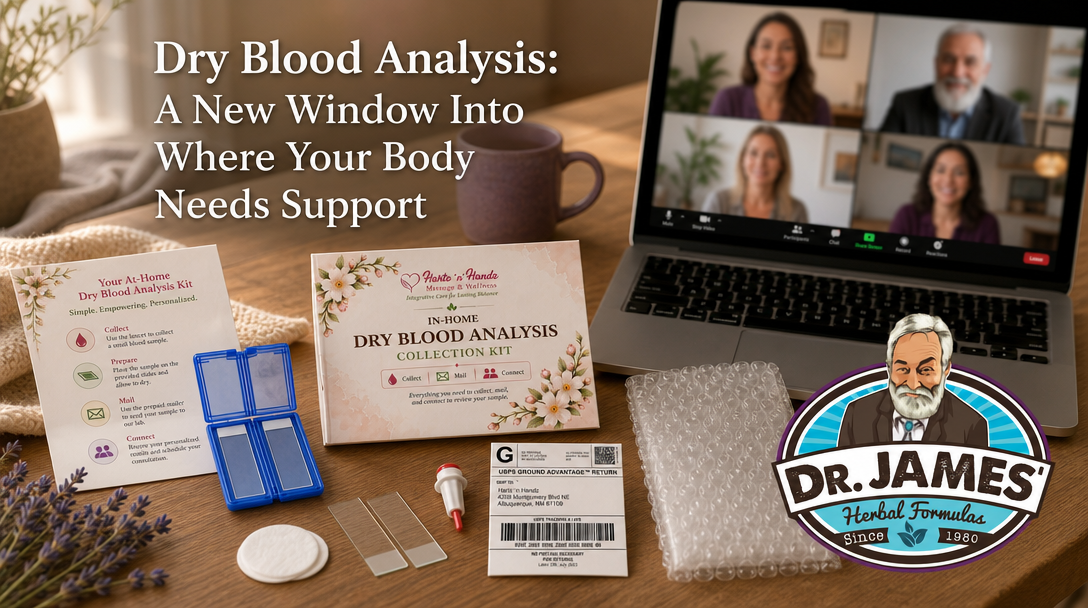
Dry Blood Analysis: A New Window Into Where Your Body Needs Support
If you ever sat across from Dr. James while he pricked your finger and studied a drop of your blood under the microscope, you remember the feeling. He'd look at the dried pattern and start describing what was going on inside you — the inflammation, the areas under stress — things that didn't show on your face, things you hadn't told him. People walked away shaking their heads, wondering how he could possibly know.
That was Dry Blood Analysis. And for years, when people called asking, "Can I get that thing with the microscope done again?" — the honest answer was that they'd have to travel to Albuquerque.
Not anymore.
Dr. James's daughter Jessica learned this technique at his side, worked as his clinic assistant for the better part of 15 years, and has carried it forward in her own practice ever since. And now — after 20 years in the works — she's made it available as an at-home kit. You collect your sample at home, mail it back, and meet with her by Zoom or phone to walk through what she observes. No matter where you live.
Here's what it is, what it isn't, and how it can help you figure out where to actually start.

First, What Dry Blood Analysis Is Not
Let's be clear up front, because it matters.
Dry Blood Analysis is not a diagnostic tool. It doesn't diagnose disease. It won't tell you whether you have diabetes, and it won't tell you whether you have cancer. It's not used to measure blood sugar. It is not a substitute for your doctor or for medical care — if you need to see a doctor, you see a doctor.
What it is, is observational. It's a way of looking at patterns in dried blood that can offer clues about how your body's systems appear to be functioning — and, most valuably, help you prioritize where to focus your wellness support. As Jessica puts it, it's like finding an unusually knowledgeable clerk at the health food store who can look at your situation and say, "You don't need all fifteen of those — you need these three, right now."
That framing runs through everything below. This is about supporting the body's systems so they can do their own work — not treating symptoms, and not replacing medical care.
The Story That Explains It Best
There's a story that captures exactly how this works.
A client once came to see Dr. James, and after studying his blood, Dr. James recommended he take Arth Rite — the arthritis formula. The man was taken aback. "I don't have arthritis. I'm not that old. It's not in my blood." He was genuinely a little upset about it.
But he trusted Dr. James enough to give it a try. Two weeks later he called back: his knees hadn't felt that good in years.
Here's the important nuance, and Jessica is careful about it: the blood didn't show "arthritis." You don't see a disease in dried blood. What you can observe is evidence of the aches, the inflammation, the stress that commonly show up in a body headed in that direction. The analysis pointed toward a pattern. Supporting that pattern brought relief. That's the whole idea — you feel the evidence, and the blood shows the evidence, and the two line up.
Live Blood vs. Dry Blood: What's the Difference?
This is one of the most common questions Jessica gets, so it's worth explaining.
Live blood analysis uses a fresh slide, usually under a cover slip, examined right away while the blood is still moving. The whole point is to capture motion — how the blood behaves, how the red and white cells look, whether they appear healthy or shriveled. Live blood can observe things dry blood never will, including things like blood glucose involvement. But because it has to be viewed immediately while fresh, it can only be done in person, with someone local.
Dry blood analysis is different. You don't look at it wet — you wait for it to dry, which takes 10 to 15 minutes depending on the humidity. And something fascinating happens as it dries: the drying blood acts almost like a centrifuge. As it sets, it pushes heavier materials — including heavy metals — toward the outer edges of the blot, the way spinning something fast presses everything against the sides. What you're left with is a pattern.
With dry blood, Jessica isn't studying motion or individual cells — she's reading those dried patterns. And those patterns can reveal things live blood can't, including observations related to heavy metals, demineralization, and liver stress. Some of the slides even offer a sense of history — how you've been doing in the recent past, and the direction you appear to be heading.
Neither test is "better." They're different tools that show different things — the way a hospital runs several different tests rather than relying on just one. But the great advantage of dry blood, the thing that makes the at-home kit possible: because the sample dries and stabilizes, you can be in Oklahoma or Pennsylvania, collect your sample, and mail it in. Live blood simply can't travel.
The Real Value: Finding the "Head of the Snake"
Here's the part that makes this genuinely useful, and it's rooted in something Dr. James taught constantly.
Anyone could take some of every formula produced. But should you? No. And is that even the most beneficial approach? Also no — not to mention nobody wants to swallow handfuls of capsules or spend money on things they don't need right now.
When Jessica examines your dried blood, she'll typically find a list of things worth noting — she promises she'll always find a list, because she's only ever worked with humans, and humans have issues. (She also promises she has never found anything hopeless in anyone's blood.) That list might include observations related to heavy metals, urinary tract stress, liver stress, adrenal exhaustion, food sensitivities, or bowel toxicity — which, she notes, is the single most common thing she sees.
But the goal isn't to hand you a list of twelve things and twelve formulas to match. The goal is to find what she calls the head of the snake — the one thing that appears to be pulling the strings on everything else. Address that, and often several of the other items on the list fall away with it. A domino effect.
Dr. James described the same principle: fix the right one thing, and several other complaints frequently resolve on their own. For a lot of people, that starting point turns out to be the digestive tract — because if you're not taking the trash out, the whole system becomes toxic. Get the digestion functioning, and a surprising number of downstream problems clear up.
Jessica had another way of getting at it, borrowed from her dad: If I had a magic wand and could wave it to fix just one thing, what would you want it to be? Start there. Handle what's bothering you most, address the head of the snake, and build from there — rather than trying to fix everything at once and getting overwhelmed.
That's the difference between a scattered pile of supplements and an actual plan.
What You Get: The Personalized Plan
After the analysis, Jessica writes up her observations on an informational page she sends to you. But it's more than a list — it's a plan tailored to you.
Depending on what she observes, that plan might include:
- Specific formulas to prioritize — for example, a focused approach on the digestive tract using something like Col Cer along with Fection, and Klean Lax or Kolonic Kaps as needed, for a defined period of time
- Foods to include or avoid for now — because sometimes what you need isn't a capsule at all, it's a change on your plate
- Cleanses where appropriate — a liver cleanse, a lymphatic cleanse — perhaps a couple before your next visit
- Practical lifestyle guidance — the order in which to eat your foods, propping your feet with a toilet stool (yes, there may be a poop talk), simple habits that make a real difference
And critically — the plan is built with you, not handed to you. As Jessica says, a plan is only as good as its results. If she designs something that looks perfect on paper but you're not willing to do it, it's a bad plan. So the two of you refine it together until it's something you can actually commit to — because consistency is what produces results, and little steps become big steps if you stick with them long enough.
A client who'd seen Dr. James years ago put it simply: the thing that made everything possible was consistency. When she stuck with it, everything got better.
Seeing Your Progress Over Time
One of the things people love most is that you can do this more than once.
Say you're working on clearing a virus. Fection is Jessica's go-to there, and the presence of a virus can actually be observed in a dry blood slide. So she might recommend a certain amount of Fection, and then you re-check down the road — and you can see it. Less virus. Then less still. And eventually, a slide with no evidence of it at all.
There's real power in that. We all second-guess ourselves — was I really that sick? Am I really that much better? Dry Blood Analysis gives you tangible evidence alongside how you feel. If your body is struggling and you need to see real proof that you're making progress, it shows in the blood. And you can compare where you started to where you are now.
Why "Be Your Own Doctor" Doesn't Work
Jessica makes an honest point that's easy to overlook.
You can have all the information in the world and still have no idea what to do with it — or feel completely overwhelmed by all the options. It's genuinely hard to be a doctor to yourself when you're the one in the middle of whatever you're feeling.
And she says this as the person who has all the information. She helps countless people — but when she's the one who's sick, she'll turn to Jim or Lynn: what do I do? When Jim gets the flu and doesn't want to get out of bed, Lynn's the one who walks in with a handful of herbs and a glass of water and says, here, take this, do this, eat this. Everyone needs an outside set of eyes sometimes. That's not a weakness — it's just how it works.
That's what Dry Blood Analysis offers: an experienced outside perspective to help you cut through the overwhelm and focus.
(That said — if you're the curious type who just wants to know what's in the blood and would rather not have recommendations, that's completely fine too. Some people, especially those who work in health food stores, love seeing the analysis and prefer to draw their own conclusions. It's always in your hands.)
How the At-Home Kit Works
The kit arrives as a full-color packet with everything you need — thoughtfully designed, not a pile of hard-to-read black-and-white instructions. Every question you might have while doing it is already answered inside, so the first step is simple: read the booklet or watch the video. (Jessica recorded herself pricking her own finger for that video — and she'll have you know she doesn't love needles, so that was true devotion.)
Here's the flow:
- Collect at home. Follow the step-by-step instructions — full-color photos with descriptions, or scan the QR code to watch the video. A simple finger prick, a few small blots on the slides, and you let it dry.
- Mail it back. The kit includes a protective blue slide mailer, bubble wrap, and — the part that makes it effortless — prepaid return shipping. You ship it back in the same box it came in. Just drop it in the mailbox.
- Schedule your consultation. By Zoom or phone. With Zoom, you get to see your own blood on screen while Jessica walks you through it: "See this spot right here? That's evidence of…" — exactly as if you were sitting in her office.
- Get your personalized plan and decide, together, what your next steps look like.
The kit is available on our website, so you can order it on its own — and if you're already ordering something else, we can simply drop it in the box. If you're local to New Mexico, you'll typically get your kit within a day, which means you could realistically be scheduled and done within a week. And if you're local but would rather not come into the office, you can still just do the Zoom.
Follow-Up That Fits You
After your consultation, Jessica may suggest a follow-up — and it's always scaled to what you actually need. For some people, that's a brief 15-minute phone check-in a couple of weeks out (write your questions down as they come up, and you'll fly right through them). For others who are chasing a bigger pattern, she might suggest a repeat Dry Blood Analysis in three months to track the progress, with a phone touch-base in between.
It's never a hard sell, and it's never one-size-fits-all. As she says over and over: it's always in your hands.
A Piece of Dr. James's Legacy, Carried Forward
What makes this special isn't just the technique. It's that this is a genuine piece of Dr. James's own practice — the thing people remember him doing — now carried forward by the daughter who learned it directly from him and has spent years developing it further.
This isn't about selling a product. It's about helping you personalize and prioritize, so you can be the healthiest version of yourself — whatever that looks like for you. It's a tool to help you spend your time and money where it will actually count, and to see, with your own eyes, the progress you're making.
Get your Dry Blood Analysis kit. here If you're local and would like an in-person or Zoom appointment with Jessica. Questions — call us at 888-388-4413.
Frequently Asked Questions
What is Dry Blood Analysis?
Dry Blood Analysis is an observational wellness assessment that examines the patterns formed as a drop of blood dries on a slide. It's the same technique Dr. James used in his clinic, now offered by his daughter Jessica. It is not a diagnostic test — it doesn't diagnose disease, measure blood sugar, or screen for conditions like cancer. Its purpose is to observe patterns that can help you prioritize which areas of your body may benefit most from wellness and herbal support right now.
What's the difference between live blood analysis and dry blood analysis?
Live blood analysis examines fresh blood immediately while it's still in motion, capturing how the cells move and behave — which requires an in-person visit with someone local. Dry blood analysis examines the patterns left after blood dries on a slide. As it dries, the blood acts like a centrifuge, pushing heavier materials such as heavy metals toward the edges, revealing patterns related to areas like liver stress, demineralization, and heavy metals. Because the dried sample is stable, it can be collected at home and mailed in, which live blood cannot.
Is Dry Blood Analysis a medical test or diagnosis?
No. Dry Blood Analysis is strictly observational. It does not diagnose disease, it is not used to detect cancer or measure blood sugar, and no prescriptions are written. It is not a substitute for medical care — if you need to see a doctor, you should. Its value is in helping you observe patterns and prioritize your wellness and herbal support alongside, not instead of, regular healthcare.
How does the at-home kit work?
You receive a full-color kit with instructions, a QR-code video, two slides, a protective mailer, and prepaid return shipping. You do a simple finger prick, place a few blots on the slides, let them dry, and mail them back in the same box. Then you schedule a consultation by Zoom or phone. With Zoom, you can view your own blood images as Jessica discusses them. She provides a written page of observations and a personalized plan.
How can Dry Blood Analysis help me choose which herbs to take?
Rather than trying to address a dozen concerns with a dozen formulas, Dry Blood Analysis helps identify the "head of the snake" — the one underlying area that, when supported, often improves several other issues at once. Jessica uses her observations to recommend a focused, prioritized set of Dr. James's formulas, along with food and lifestyle guidance, so you can direct your time and money where they'll have the most impact rather than taking a little of everything.
Can I track my progress over time?
Yes. Because patterns like the presence of a virus can be observed in dried blood, you can repeat the analysis later to see change over time — for example, watching evidence of a virus diminish as you support your body. Many people value this tangible feedback alongside how they feel, and comparing an earlier slide to a later one can show meaningful progress.
Jim and Lynn Applegate host the Reality of Herbal Therapy podcast. Lynn and Jessica are both daughters of Dr. Michael James, founder of Professional Herbal Instruction and Dr. James' Herbal Formulas. Jessica served as Dr. James's clinical assistant for approximately 15 years and has offered Dry Blood Analysis in her own practice since 2018.
Dry Blood Analysis is an observational wellness assessment. It is not a medical diagnostic test, does not diagnose disease, and is not a substitute for laboratory testing or medical care. These statements have not been evaluated by the Food and Drug Administration. These products are not intended to diagnose, treat, cure, or prevent any disease.
![[Podcast] What Your Blood Can Tell: Inside Dry Blood Analysis with Jessica](http://www.drugfreehelpstore.com/cdn/shop/articles/PODCAST_Dry_Blood.jpg?v=1788553523&width=1500)
![[Podcast] Heal Your Gut, Shield Your Immunity: Fection & Col Cer Deep Dive](http://www.drugfreehelpstore.com/cdn/shop/articles/gut-immune.png?v=1789161146&width=816)
