Why There's Diatomaceous Earth in Tissue Mend — And Why It Belongs There

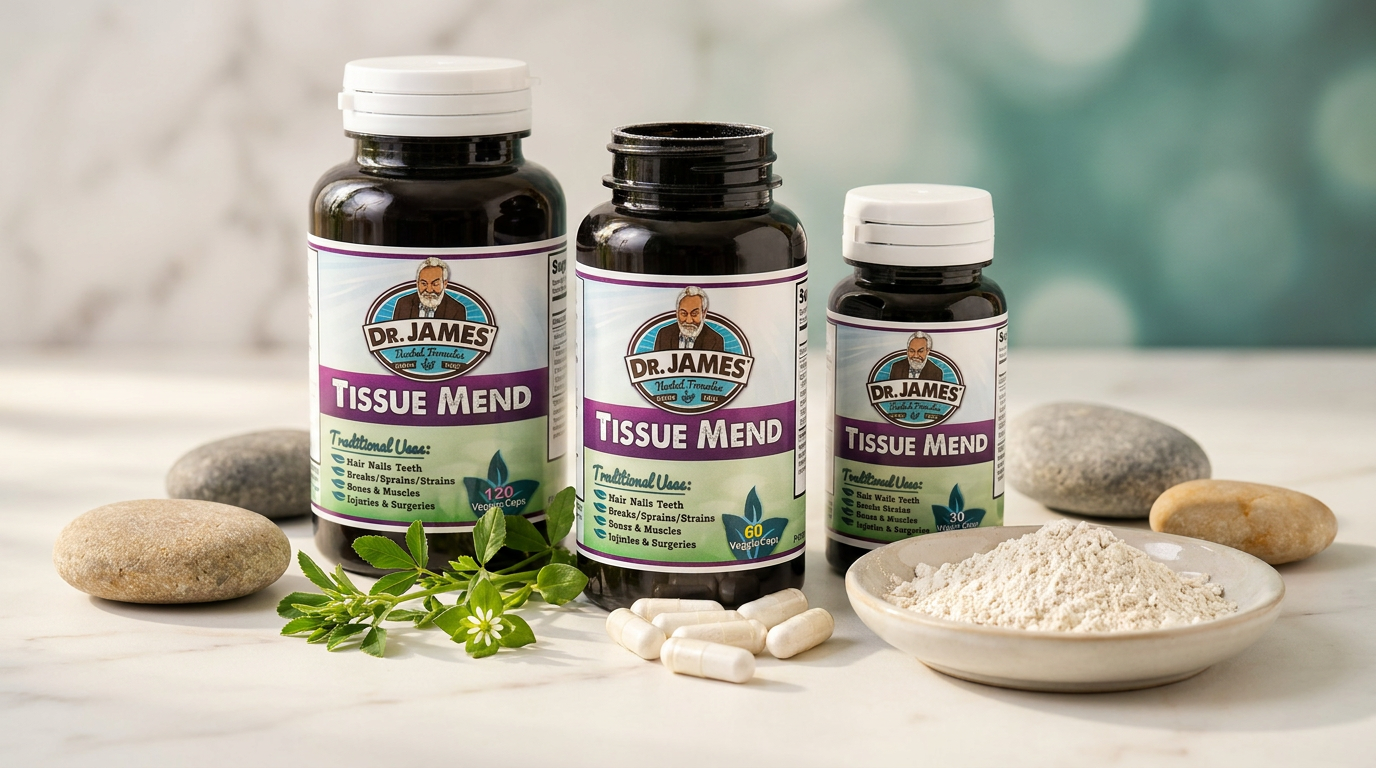
Every few months, someone reads the label on Tissue Mend, sees diatomaceous earth, and stops cold. Usually it's because they've heard you should never breathe the powder — and that's true. But that single fact, taken out of context, has talked a lot of people out of one of the most useful ingredients we've ever put in a formula. I've been adding food-grade diatomaceous earth to Tissue Mend for more than twenty years, on purpose, and I want to walk you through exactly why — because once you understand what it does in a capsule, the worry tends to disappear and the reason to take it becomes obvious.
This is the conversation I've had at the counter and over the phone more times than I can count. Let me give you the whole thing in one place.
What Most People Get Wrong About Diatomaceous Earth
Here's the heart of the confusion: the warning people have heard is real, but it's a warning about dust in the air, not powder in a capsule.
Direct answer: Diatomaceous earth is only a respiratory concern when the loose powder is inhaled. The fine particles can irritate the lungs, throat, and nasal passages if you breathe a cloud of it. Sealed inside a swallowed capsule, none of that applies — it never reaches the lungs. It goes to the stomach and the gastrointestinal tract, which is exactly where we want it to work.
I always tell people: this is the same reason you wear a mask sanding drywall, but you'd happily eat the same minerals in your food. The danger isn't the substance — it's the route. Breathe fine mineral dust of almost any kind, day after day, and your lungs will complain. Swallow food-grade diatomaceous earth and your digestive tract handles it the way it was built to.
There's one more distinction that matters, and it's the one that separates a quality formula from a careless one. Diatomaceous earth comes in two forms. Food-grade diatomaceous earth is made mostly of amorphous silica — the soft, inert, fossilized-diatom kind. Industrial or filter-grade is heat-treated into crystalline silica, which is the genuinely hazardous form used in pool filters. They are not interchangeable. Food-grade diatomaceous earth is recognized by the FDA as GRAS — Generally Recognized As Safe — and contains under 1–2% crystalline silica by design. That's the only kind that has ever gone into Tissue Mend.
What Diatomaceous Earth Actually Is
Definition: Food-grade diatomaceous earth is a fine, off-white powder made from the fossilized skeletons of diatoms — microscopic freshwater algae. Those skeletons are made almost entirely of silica. When the deposits are mined, sifted, and milled, what's left is roughly 80–90% amorphous silica and a spread of trace minerals.
So when you swallow it, you're essentially swallowing fossilized silica. And silica, it turns out, is something most of us are quietly running short on.
Reason One: Silica Is the Raw Material Your Tissue Is Built From
This is the reason diatomaceous earth earns its spot in a formula literally named for mending tissue.
Silica is one of the building blocks your body depends on to form collagen — and collagen is the framework underneath your skin, hair, nails, tendons, ligaments, cartilage, and bone. Silica plays a role in calcium absorption and collagen formation, which are crucial for maintaining strong bones and healthy connective tissue. When your body is repairing itself after a strain, an injury, or just the ordinary wear of hard physical work, it needs a greater abundance of these raw materials than a normal diet tends to supply.
And here's the part most people don't realize: silica is essential for collagen cross-linking, which maintains skin elasticity, bone density, joint cartilage, and hair tensile strength. Most modern diets are silica-deficient. The soil our food grows in has been depleted for decades, and the silicon content of plant foods depends entirely on that soil. So even people who eat well are often coming up short on the one mineral the body leans on to rebuild its own structure.
That's the whole philosophy behind Tissue Mend: give the body an abundance of the building blocks, and let the body do the mending. The diatomaceous earth is there to make sure silica is one of those building blocks.
Reason Two: Silica Supports Bone and Calcium — Not Just Hair and Nails
People notice the cosmetic effects first — and they're real. The silica in Tissue Mend is the same compound sold on its own in those expensive hair, skin, and nail supplements at the pharmacy. Stronger nails and faster-growing hair are the side effects people report most, and they're a visible sign that the silica is doing its job on every other tissue you can't see.
But the deeper benefit is structural. Silica within diatomaceous earth helps with normal bone metabolism and joint formation, with evidence over the past 30 years suggesting there's a positive association between dietary silicon intake and better bone mineral density. The proposed mechanism is exactly what you'd hope for in a tissue formula: silicon helps with synthesis of collagen — used to form joints, the lining of the digestive tract and connective tissue — and within the mineralization of bones. Silica also appears to improve the body's use of calcium, which is why I've always considered it a partner to a good mineral program rather than a replacement for one.
Reason Three: It Acts as a Gentle Absorbent in the Gut
The second job diatomaceous earth does has nothing to do with silica and everything to do with its physical structure.
Those fossilized diatom skeletons are porous and mildly absorbent. As the diatomaceous earth moves through the digestive tract, it acts as a gentle absorbent that helps carry waste and unwanted organisms along and out of the body. This is the "internal housekeeping" role — it supports the body's own process of clearing out what it doesn't need.
I want to be careful and honest here, because it's where exaggerated claims live. The absorbent action is mechanical and gentle. It is not a drug, it does not strip the gut, and the human digestive tract — with its protective mucosal lining — is well-equipped to handle it. The human digestive tract, with its protective mucosal lining, is resistant to this physical action, which is what makes the same property that bothers a soft-bodied parasite a non-issue for your gut lining.
Reason Four: Emerging Support for Healthy Cholesterol and Lipids
This one is newer, and I'll frame it the way the research frames it — as promising, not proven.
Several studies have looked at silicon from diatomaceous earth and its effect on blood fats. A 1998 study showed DE cut total cholesterol by 13.2% in 8 weeks. More recent work points in the same direction: silicon appears to play a role in how the body handles fats after a meal. Silicon is an essential trace element involved in bone formation, connective tissue integrity, and cardiovascular health. I don't put this forward as a reason to take Tissue Mend for your heart — that's not what the formula is for. I mention it because it's one more example of silica being a quietly useful mineral that most people aren't getting enough of.
Is It Safe? The Honest Answer
Direct answer: Food-grade diatomaceous earth is recognized by the FDA as Generally Recognized As Safe (GRAS), and when swallowed it is not meaningfully absorbed into the bloodstream — most of it passes through and is eliminated. Studies have shown that when small amounts are consumed, the amount of silicon dioxide excreted in the urine remains unchanged, supporting the conclusion that it is not systemically absorbed.
The one caution worth repeating is the one we started with: don't inhale the loose powder. That's a handling instruction, not a swallowing instruction. In capsule form, that risk is simply off the table.
As always, our philosophy is that more caution is better, not less. If you're pregnant, nursing, or managing a health condition, let your doctor know what you're taking — that's true of every supplement, and an all-natural one is rarely something a physician objects to.
What This Means for You — A Practical Path
If you've been hesitating over Tissue Mend because of the diatomaceous earth, here's how I'd think it through:
- Confirm it's food-grade. Ours always is. That's the form that's GRAS and the form your body handles easily.
- Remember the capsule changes everything. The lung warning is about airborne dust. Swallowed, it goes to the gut, not the lungs.
- Take it for the silica. That's the real prize — the building block your skin, hair, nails, joints, and bones use to rebuild, and the one most diets fall short on.
- Watch for the "side effects." Stronger nails and faster-growing hair are the visible signs that the silica is working everywhere else, too.
- Be consistent. Tissue is rebuilt slowly. The people who get the most out of Tissue Mend take it daily and give it time.
Frequently Asked Questions
Is it safe to swallow diatomaceous earth in a capsule?
Yes — food-grade diatomaceous earth is recognized by the FDA as GRAS, and in capsule form it goes to the digestive tract, never the lungs. The well-known warning about diatomaceous earth is specifically about inhaling the loose powder, which doesn't apply once it's enclosed and swallowed.
Why is there diatomaceous earth in Tissue Mend at all?
It's there for two reasons: it's an exceptional natural source of silica — the building block your body uses to form collagen for skin, hair, nails, tendons, ligaments, and bone — and it acts as a gentle absorbent in the gut that supports the body's own clearing of waste and unwanted organisms.
What's the difference between food-grade and industrial diatomaceous earth?
Food-grade diatomaceous earth is mostly amorphous (soft, inert) silica and is recognized as safe for consumption. Industrial or filter-grade is heat-treated into crystalline silica, which is hazardous and used for things like pool filters. Only food-grade diatomaceous earth belongs in a supplement, and that's the only kind in Tissue Mend.
Will Tissue Mend really help my hair and nails?
Many people report exactly that. Stronger, faster-growing nails and healthier hair are the most commonly reported effects, because hair and nails are silica-rich tissues — and they're a visible sign that the silica is supporting the connective tissue throughout your body that you can't see.
Does the diatomaceous earth get absorbed into my body?
Very little of it does. Research shows most swallowed food-grade diatomaceous earth passes through the digestive tract and is eliminated, while the small amount of silicon that is absorbed circulates briefly and is cleared by the kidneys. It does its work in the gut, then leaves.
The Bottom Line
The ingredient that scared you off is, once you understand it, one of the best reasons to take Tissue Mend. The lung warning is real — for airborne powder. Inside a capsule, food-grade diatomaceous earth becomes a quiet, steady source of the silica your body uses to rebuild itself, plus a gentle absorbent that supports good digestive housekeeping. That's not a flaw in the formula. That's the formula working exactly as it was designed to, the same way it has for over twenty years.
If you'd like to see the full ingredient list or talk it through, we're glad to help — that's what we're here for.
This article is for educational purposes and is not intended to diagnose, treat, cure, or prevent any disease. These statements have not been evaluated by the Food and Drug Administration. Talk with your healthcare provider about any supplement you take.