
Article: The Truth About Seed Oils: Why the "Heart-Healthy" Oil in Your Kitchen May Be Making You Sick
The Truth About Seed Oils: Why the "Heart-Healthy" Oil in Your Kitchen May Be Making You Sick
Seed oils may be the single most misunderstood ingredient in the American kitchen. For more than seventy years, we were told that canola, soybean, and "vegetable" oils were the heart-healthy choice — and that the butter, lard, and tallow our grandparents cooked with were the danger. This week on The Reality of Herbal Therapy, Jim and Lynn Applegate sat down with Cherie Calbom — known worldwide as "The Juice Lady," a nutritionist with a master's degree in whole food nutrition and the author of 36 books, including her latest, The Truth About Seed Oils.
What follows is her account of how that story got written, why she believes it was backwards, and what she does in her own kitchen instead. It's a conversation that lined up remarkably well with something Dr. Michael James taught in his seminars for decades: it's not the fat that's the problem — it's which fat, and what's been done to it.

What Most People Don't Know About Where Seed Oils Came From
Here's the piece of history Cherie says changed how she saw the whole category: seed oil wasn't originally made to eat.
Before World War II, coconut oil was advertised in America as the healthiest oil on earth. Then the war came, and tropical oils couldn't make it across the oceans. The seed oil industry — small until then — saw an opening and began mass-producing what they renamed "vegetable oils." But those oils had started life as something else entirely. As Cherie tells it, seed oil was first produced as an industrial lubricant for machinery, used on ships and airplanes during the war. It was dark, smelly, and unpleasant, and turning it into something that looked like food took real work: deodorizing, bleaching, high heat, and in many cases a chemical solvent like hexane to squeeze more oil from the seed.
After the war, with a surplus and a factory system already built, that golden, deodorized oil rolled into plastic bottles on grocery shelves — rebranded, in Cherie's words, because "they needed a new reputation, not machine lubricant."
The "Heart-Healthy" Label and the Story Underneath It
Why were seed oils ever called heart-healthy in the first place?
According to Cherie, it traces back to how heart disease was investigated in the 1950s. Heart attacks, rare before 1950, climbed sharply after. Researchers doing autopsies found plaque in the arteries, and inside the plaque they found fat and cholesterol — so fat and cholesterol took the blame. But Cherie argues they stopped one layer too soon: underneath the plaque was inflammation, an irritation in the artery wall that the plaque was building over, "like a scab would build up over a cut."
Her point of view is that the fat in the plaque was the patch, not the puncture — and that the real irritant was the very oils being promoted as the cure. A few "common sense voices," she notes, pushed back at the time: we'd eaten butter, lard, red meat, cheese, eggs, and coconut oil for centuries without this epidemic. What was actually new on the block was the seed oil.
A note on this: This is Cherie Calbom's argument, drawn from her book and her decades in whole-food nutrition. The science around seed oils and heart disease is genuinely debated, and we share her perspective for your consideration — not as settled medical fact. As always, your own doctor is the right person to weigh this for your situation.
Dr. James, Lynn noted during the episode, was making a version of this same case in his own seminars years ago — that diet, and the plaque-and-inflammation picture underneath it, deserved a much harder look than it was getting.
The Good Oils: A Simple Rule You Can Remember
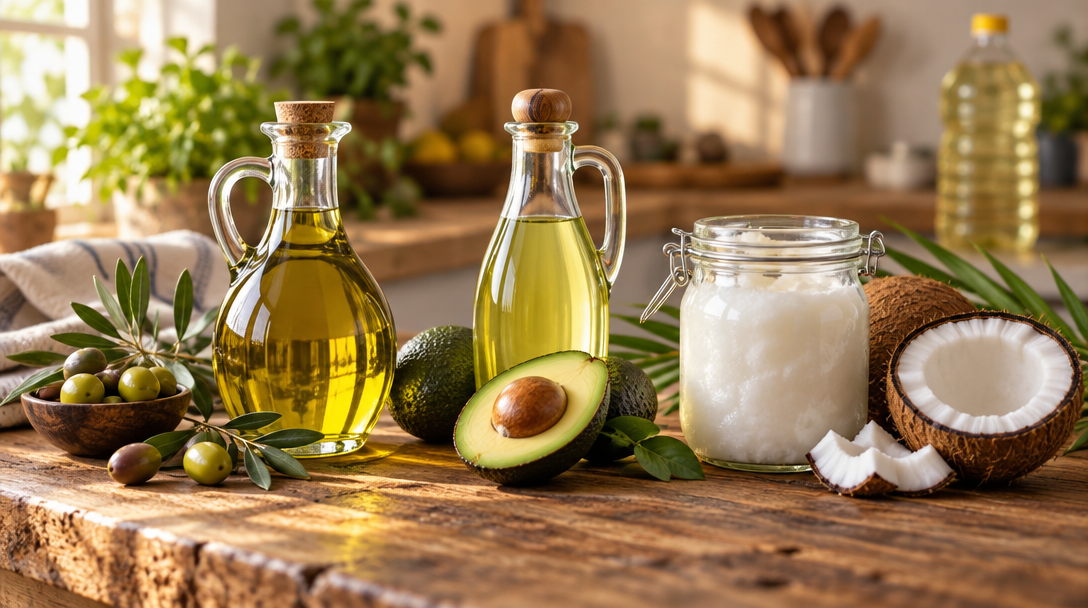
If the takeaway from the history is "be skeptical of the golden bottle," the practical replacement is refreshingly simple. Cherie's rule is to stick with fruit oils — oils pressed from the flesh of a fruit rather than extracted from a seed.
Fruit oils (the ones to keep):
- Olive oil
- Avocado oil
- Coconut oil
Seed and "vegetable" oils (the ones she avoids):
- Canola
- Soybean (she notes it's cheap, heavily GMO, and "in everything")
- Safflower and sunflower
- Grapeseed
- Rice bran
- Peanut
For animal fats, Cherie keeps grass-fed butter, ghee (from grass-fed sources), and tallow on the "good guy list" — always looking for organic and grass-fed. Beef tallow, she points out, has a high smoke point of around 500°F, which makes it far more stable for high-heat cooking than a delicate seed oil that denatures and creates toxic byproducts when it starts to smoke.
A piece of history the Applegates found striking: Kentucky Fried Chicken and McDonald's both originally fried in beef tallow. And the movement back toward it is real and growing — Steak 'n Shake switched to beef tallow for its fries over a year ago, and even the Tennessee Titans went seed-oil-free as a team.
Why "Low-Fat" Was the Wrong Turn
Isn't the safest move just to avoid fat altogether?
Cherie's answer is an emphatic no — she calls the no-fat, low-fat diet "dangerous." Her reasoning is structural: the body needs roughly 30% of the diet to come from good fats, because the membrane around every cell is made of fat. The body is in constant turnover, and if the right fats aren't available to rebuild those membranes, it uses inferior ones — damage at the cellular level.
The brain is the clearest example. It's largely fat, with a significant amount of cholesterol, and Cherie connects decades of fat-phobia to rising rates of dementia and Alzheimer's — one factor among many, she's careful to say, not the only one. She also cites Dr. Mary Enig's work on the saturated fats C16 and C18, dominant in coconut oil and present in animal fats, which the heart draws on in times of stress.
And the irony she points to: the low-fat era was supposed to make us thinner. Instead, as fat came out, sugar went in, and the nation got heavier. "People have to have something," she said. "They're going to replenish their diet with sweets, sugar instead."
The Cells Are Always Turning Over — Which Means There's Always a Way Back
The most hopeful part of the conversation was also its scientific core. Because your cells are constantly being replaced, Cherie argues, every meal moves you in one direction or the other. Put the good stuff in, and the body builds healthier cells, healthier membranes, healthier interiors. Keep putting the damaged fats in, and it builds from those instead.
She speaks from her own history here. In her twenties she was severely ill — chronic fatigue syndrome and fibromyalgia, unable to work, "sicker than an old dog." A five-day vegetable juice fast and a summer of plant-based eating started a turnaround that, over three months, restored her to what she now calls vibrant health. Her hard-won lesson: "Seven minutes of pleasure in your mouth and seven days of feeling nasty — that is just not worth it."
Getting the Good Oils Into Real Life
The practical question Jim asked is the one most people actually have: how do you get these oils into your day?
For Cherie, it's mostly olive oil and coconut oil for everyday cooking — scrambling eggs, sautéing onions and vegetables — with a little butter or beef tallow now and then for flavor, especially burgers and steaks. One seasonal favorite she shared: baked acorn squash with a little butter, a little coconut oil, and a generous amount of pumpkin pie spice. "It was like dessert to me."
And for families with children — or anyone resistant to change — her no-bake coconut oil treats are a clever way to sneak good fat in:
- Start with coconut oil as the base.
- Stir in honey and almond butter (or a good peanut butter).
- Add nuts and chopped dates for texture and natural sweetness.
- Add cacao if you want it more like a chocolate bar.
- Spread on a tray, freeze, then cut into chunks and keep in the fridge or freezer.
When the kids want something sweet, they grab a piece — and get a dose of good fat without thinking about it. She shared a second crowd-pleaser too: a chocolate pudding made from full-fat coconut milk, an avocado, cacao or cocoa powder, a little stevia or monk fruit, and vanilla, all blended smooth. She serves it at her wellness retreats, and guests who "aren't into health at all" can't believe there's avocado in it.
The One Trick That Changes Everything: Read the Label
If there's a single action from this episode, it's this — become a detective at the grocery store. Seed oils hide under a dozen names (vegetable oil, corn, soy, safflower, sunflower, grapeseed, canola), and the print keeps getting smaller. Lynn photographs labels and zooms in; Cherie shops with a lit magnifying glass.
The shortcut she recommends is the Seed Oil Scout app, which has a scanner for barcodes and a map that shows seed-oil-free restaurants near you. (There's a free trial linked from her site.) It turns an exhausting label-reading chore into a quick scan — especially helpful, as Lynn pointed out, for a parent shopping with little ones in the cart.
Cherie's own story of the payoff: she and her husband discovered that when they traveled, bringing their own coconut oil, sea salt, and sugar — even when everything else about the meal was the same — kept them from getting "cranky and tired and feeling awful." It was the ingredients all along, right down to the salt.
Frequently Asked Questions
What are seed oils, and why are they controversial? Seed oils are oils extracted from the seeds of plants — canola, soybean, sunflower, safflower, grapeseed, corn, and others — usually through high heat and chemical processing. They're controversial because, despite decades of "heart-healthy" marketing, a growing movement (including nutritionist Cherie Calbom) argues they promote inflammation and were never the healthy choice they were sold as.
Which cooking oils does Cherie Calbom recommend instead? She recommends "fruit oils" — olive oil, avocado oil, and coconut oil — plus grass-fed animal fats like butter, ghee, and beef tallow. She avoids all seed and "vegetable" oils, including canola, soybean, safflower, sunflower, grapeseed, rice bran, and peanut.
Is beef tallow actually healthy to cook with? Cherie points to beef tallow's high smoke point — around 500°F — which makes it more stable for high-heat cooking than delicate seed oils that break down and create toxic byproducts when they smoke. It's one reason restaurants like Steak 'n Shake have returned to it for frying.
Why is a low-fat diet a problem? According to Cherie, the body needs roughly 30% of its diet from good fats to rebuild cell membranes, support the brain, and fuel the heart under stress. When fat is removed, it's usually replaced with sugar — which she connects to rising rates of obesity rather than the weight loss low-fat diets promised.
How can I tell if a product contains seed oils? Read the ingredient label — seed oils hide under names like vegetable oil, canola, soy, corn, safflower, sunflower, and grapeseed. Cherie recommends the Seed Oil Scout app, which scans barcodes and flags products containing seed oils.
Can switching oils really make a difference if everything else stays the same? Cherie and the Applegates both describe noticing fast, noticeable changes — in energy, headaches, and how they felt overall — from changing only the oils, salt, and sugar they used, while keeping the rest of their diet the same. Individual results vary, and this reflects their personal experience.
Want to go deeper? You can find Cherie Calbom's book The Truth About Seed Oils on Amazon, Audible, Kindle, and at Barnes & Noble, and connect with her at juiceladyinfo.com and thetruthaboutseedoils.com, where she offers a free anti-inflammatory recipe guide and a 21-day meal plan.
And for more real-food wisdom in the tradition of Dr. Michael James, explore the Dr. James' Herbal Formulas and the free Healer in Every Home guidebook at drugfreehelpstore.com, or call 888-388-4413.
The views and opinions expressed by guests on The Reality of Herbal Therapy are their own and do not necessarily reflect those of Professional Herbal Instruction. We share a range of perspectives for your consideration.
These statements have not been evaluated by the Food and Drug Administration. This content is for educational purposes only and is not intended to diagnose, treat, cure, or prevent any disease. Always consult a qualified healthcare provider before making changes to your health routine, especially if you have a medical condition or take medication.

