
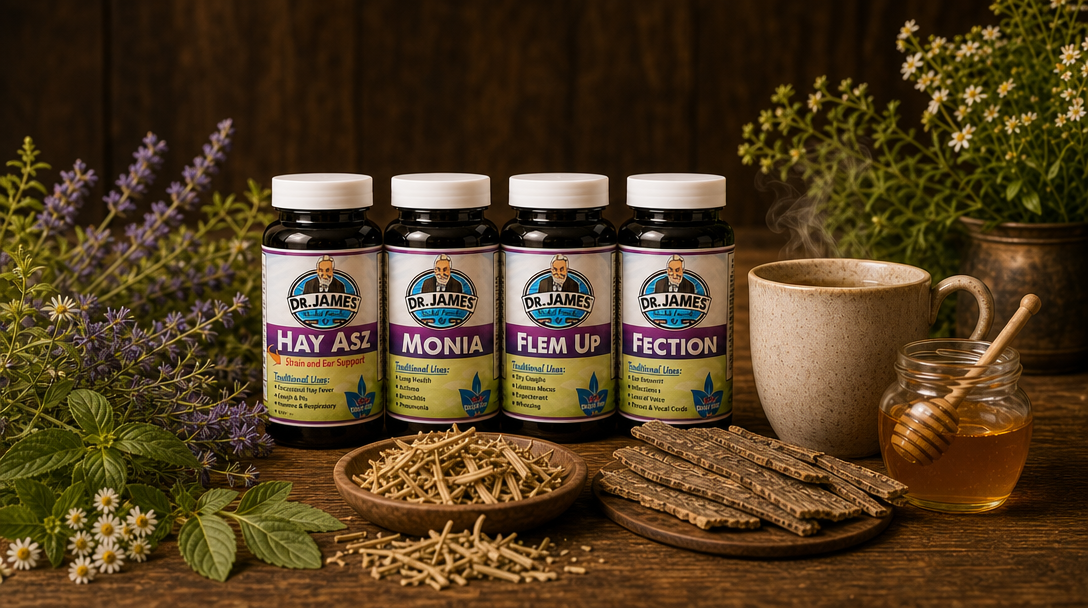
Herbal Defense Kit: Hay Asz, Monia, Flem Up & Fection Unpacked

When something goes around, it almost always starts the same way.
A runny nose. A scratchy throat. A cough that shows up out of nowhere. The upper respiratory stuff is the thing that gets everybody — and it's usually the doorway that everything else walks through. Catch it there, at the very first sign, and you can stop it before it settles into your chest and knocks you flat for three days.
That's what this is about. Not a cabinet full of thirty different products, but four formulas that work together to cover your entire respiratory system — from your sinuses down to the bottom of your lungs. Hay Asz. Monia. Flem Up. And Fection.
Learn what each one does, and you'll always know exactly which to reach for.
The First Question: Where Is It Coming From?
When someone comes to Jim with a cough, the first thing he asks is always the same: where is it coming from?
Is it down in the lungs? Is it an itch in the throat? Is it something draining down the back of your throat from your sinuses? The answer tells you which formula you need — because the respiratory formulas are organized by territory.
Here's the map that makes everything else make sense:
Hay Asz — from the throat up. The nose, the sinuses, the throat. Upper respiratory.
Monia — from the throat down. Into the lungs and everything in the chest.
Flem Up — one job. Move the phlegm out.
Fection — the tag-along. Not a respiratory formula at all, but the immune and lymphatic support that goes with every single one of the others.
Once you know where the trouble is, you know what to grab. Let's take each one in turn.
Hay Asz: The Upper Respiratory Workhorse
The name comes from three things blending together: hay fever, asthma, and allergies. But Dr. James used it for far more than allergies.
People would come to him with a runny nose and he'd tell them to take Hay Asz. "Oh, but I don't have allergies," they'd say. Didn't matter. Anything that has to do with the upper respiratory system — colds, sore throat, runny nose, cough, congestion, sinus pressure — Hay Asz is what you reach for. It doesn't attack a specific illness. It supports, feeds, and nourishes the upper respiratory system so it has what it needs to handle everything you're breathing in.
What's Inside Hay Asz
Hyssop helps with the irritated throat and sinus congestion. Marshmallow root soothes the mucous membranes — anywhere in the body, but it's especially remarkable for the respiratory system. Oregano and paprika round it out, both high in vitamin C (which your body burns through fast when it's fighting anything respiratory) and both natural decongestants that help open the airways.
Then there are the two allergy herbs that surprise people: alfalfa and juniper.
The Alfalfa and Juniper Paradox
Here's something that sounds backwards at first. If you're allergic to hay, wouldn't alfalfa make it worse?
Just the opposite. There's an old account of farm boys who chewed on alfalfa while they plowed the fields — and somehow it kept their sinuses from acting up. Someone once tried to run a little experiment, offering to pay the men to stop chewing alfalfa for a set stretch of time. Not one of them made it. Their allergies came roaring back, and they went right back to chewing alfalfa to keep their sinuses under control.
Juniper works the same way. Around New Mexico, when juniper season hits, everything turns yellow — you walk out in the morning and your car is coated in yellow pollen. People say they're allergic to juniper, and they are — but here's the key distinction: it's the pollen that triggers the allergy, not the berry. The juniper in Hay Asz is the berry. That berry actually helps build your tolerance to the very pollen that's making you miserable, the same way small exposures build immunity. The things that seem to cause the allergy can be the very things that relieve it.
Why There Are Two Hay Asz Formulas
This trips people up, so here's the clear version. There are two Hay Asz formulas: Hay Asz Extra Strength and what we call Hay Asz Regular.
The difference comes down to one herb: Brigham tea. Brigham tea — a traditional herb of the Southwest, sometimes called Mormon tea — is in the Extra Strength version. It's drying, and it's stimulating, in the sense that it brings extra movement into the upper respiratory system. So if your sinuses are extra, extra dry, the Extra Strength with Brigham tea is often the one people reach for.
When Brigham tea became difficult to source reliably, Dr. James built a second version — the Regular — that delivers similar upper respiratory support using hyssop, comfrey, marshmallow, elder flowers, elecampane, fenugreek, and nettle. Both are still available. Extra Strength remains the one most people choose.
The Nose Trick: Swab It
When your nose is running, that actually means your nose is dehydrated — your body is trying to lubricate it. So one of the most effective things you can do alongside Hay Asz is swab the inside of your nose with a good salve.
For years the go-to was Comfrey Gold salve. But Lynn has shifted to the marshmallow root salve — now called Eye Salve, because people kept getting confused about why there were marshmallows in it. Because it focuses on mucous membranes, it soothes the nose and sinuses faster, and the residual effects aren't nearly as bad. Swab deeply and generously.
When to Reach for Hay Asz
First sign of a cold. Sinus issues. Seasonal allergies. Itchy throat, watery or itchy eyes. A random sneezing fit out of nowhere — who cares what's causing it, get on top of it before it gets on top of you. If a kid mentions their ears feel a little itchy or off, that's the moment.
And Jim never hands anyone Hay Asz without at least one Fection alongside it. More on that below.
Monia: The Lung Builder
If Hay Asz is from the throat up, Monia is from the throat down — into the lungs.
Dr. James originally made this formula for his own mother, Grandma Ella, who had pneumonia four or five times, and it got worse every time. Every winter she lived in fear of a cold, because for her a cold could turn into pneumonia fast.
The Walking Pneumonia Man
Dr. James was once called to help a man who'd been in bed for weeks, coughing and wheezing. The doctors called it "walking pneumonia" — which made Dr. James scratch his head, because the only ones doing any walking were the physicians, not this man flat on his back in bed.
Because it was pneumonia — a lung problem — the lungs were what needed help. Back then Dr. James traveled with a mail truck and often made teas on the spot. He opened Monia capsules into water, sweetened it with honey (Monia is spicy on its own — this is not a mild tea), and had the man sip it. By the time he finished the cup, he was already feeling better.
There's something about the warmth of a tea. It permeates your head, your chest, your lungs — and it carries the herbs into your system faster. That's why, for a deep lung situation, the tea is so useful alongside the capsules: the tea runs down your throat soothing everything as it goes, and the capsules keep the work going afterward.
Feeling Better Wasn't the Goal
Here's the part most people miss. Dr. James told the man that getting him well and out of bed was not the only goal. Because he'd had pneumonia, he'd be more susceptible to it again — exactly the way Grandma Ella got it year after year.
So he told the man to keep taking Monia for three months to rebuild his lungs. When you've had pneumonia badly enough, you can be left with scar tissue and weakened lung tissue. Staying on Monia keeps you from regressing, helps the body heal and move forward, and reduces the risk of it coming back.
If you're someone who keeps getting lung trouble, taking one Monia a day through the entire flu season is a reasonable way to never take your chances. It doesn't take a handful — one or two, three to five times a week, is enough to keep the lungs strong and rebuild any damage.
What's Inside Monia
Pleurisy root — named after the very illness it addresses. Pleurisy is when the lungs aren't healthy enough to pull in the oxygen they need, and pleurisy root helps with that, along with bronchitis, asthma, cough, and pneumonia. It helps heal the lungs so they can function properly.
Horehound is remarkable for congestion, hoarseness, and coughs. (If you grew up in the James household, you remember the horehound drops — sugar-coated, and depending on who you ask, either a beloved treat or the grossest thing on the planet. Lynn sucked the sugar off and swallowed the rest like a pill.)
Cayenne brings circulation to the lungs — more blood flow means more oxygen — and it speeds up the action of all the other herbs by opening everything up so they can do their job.
Flem Up: The Mucus Mover
Flem Up does one thing and does it well: it moves the phlegm.
Dr. James really, really wanted to name this one "Hock 'n' Spit." The family sat around the front room naming the formulas, and when he said "Hock 'n' Spit," one of the girls said, "Oh Daddy, you can't name it that!" So it became Flem Up. He even went to his own mother to try to overrule the kids — her response was a flat "Oh, Michael." Even Grandma overruled him. But as everyone admits, Hock 'n' Spit is exactly what the formula makes you do.
One Specific Job
You know the feeling: a cough that hurts, where something ought to come out but won't. You're coughing and coughing and it feels like something should be moving, but it just stays stuck. With kids, you can often hear it even when they can't describe it.
That stuck mucus is the problem, because things that stay stuck turn into infections — whether in the lungs or up in the nose. Flem Up moves the mucus out of the lungs so they can function. The mucus itself serves a purpose — your body wraps whatever it's fighting inside that mucus to protect itself — but then you have to get the mucus out, and that's Flem Up's whole job.
It pairs so well with Monia that it's often the missing piece. People say they've been taking Monia and it's just not quite getting them better. The first question: are you taking any Flem Up with it? Usually the answer is no. Add the Flem Up, and it's night-and-day — because once Flem Up clears the buildup out, Monia can finally do its job. Taking Monia alone with a lung full of mucus is fighting uphill.
The Quart of Mucus
Early in his practice, Dr. James went to see a man whose lungs were so congested you could hear them rattling. He made a Flem Up tea out in his mail truck and brought it in.
At herbal college, his teacher had warned that this formula could cause enough of a reaction that the person might vomit — and that this would be a good sign, because what came up would be the mucus from the lungs. But Dr. James was early in his practice, hadn't seen it himself, and didn't really warn the man.
The man drank the tea, and within moments bolted for the bathroom and threw up a dark blackish-green mass of phlegm from his lungs. Dr. James, caught off guard, could only remember to pat him on the back and tell him he was doing good — this is what's supposed to happen. The man had had asthma badly for years. After he got that gunk out, Dr. James never had to treat him for asthma again.
That doesn't happen to everyone — most people never vomit with Flem Up, and plenty of people take it for years without ever having that reaction. But when a body needs to clear something that's been built up for a long time, this is the formula that does it.
What's Inside Flem Up — and the Dosage Caution
Black cohosh helps with asthma, coughs, and congestion, and is an antispasmodic — it calms the hard lung contractions of an asthma-attack-like spasm. Slippery elm moves the mucus out of the lungs. Lobelia relaxes the lungs — relaxed enough that they can push the mucus out — and is the herb behind the more forceful clearing. Lemongrass is loaded with easily absorbed vitamin A that helps the lungs heal after the mucus clears.
Dosage: most people, one a day. If you didn't catch it up front and you're trying to get over something, one capsule up to three times a day, usually over about a ten-day stretch. You won't have to wonder whether it's working — you'll see the evidence fast.
The key caution: if mucus is coming out too fast (the vomiting reaction), cut back on the dose. And drink water. Water thins the mucus so your body can move it — thick mucus is a sign of dehydration. Not two gallons a day, but if you're not normally a water drinker, start while you're recovering. Just don't overdo it to the point of washing the minerals out of your system.
Fection: The One That Goes With Everything
Fection isn't a respiratory formula. But it's the one Lynn never leaves out — because it's taggable. It's the formula that gets taken along with whatever else you're taking.
Lynn doesn't take Hay Asz, Monia, or Flem Up without also taking Fection. She's had major sinus infections, major lung infections — and since he started tagging Fection onto whatever respiratory formula she's using, it's changed her world. It keeps her from ever getting to that horrible, deep-sick state.
Here's why it matters: the respiratory trio works on the respiratory tissue — the sinuses, the lungs, the mucus. Fection works on the immune system and lymphatics that are fighting the actual infection underneath. When you tag Fection onto Monia, it keeps things moving in and out of your body — your lymphatics, everything — because clearing your lungs and keeping them healthy is a big deal. The more gunked up your lungs are, the less oxygen you get, and the more tired and groggy you feel.
The trio treats the tissue. Fection supports the fight. That's why it belongs in every respiratory situation.
How to Layer Them: The Whole System
Here's the beauty of understanding the territory. You build your response based on where the trouble is:
Upper respiratory — throat up. Runny nose, sore throat, sinus drainage, itchy eyes. → Hay Asz + Fection. Swab the nose with salve, too.
Moving into the chest — a deep cough developing. → Add Monia to support the lungs.
Mucus taking up residence — a rattling cough that won't produce. → Add Flem Up to move it out.
It's everywhere — head cold and coughing from the lungs at once. → Take all of them.
Dr. James had a teaching that ties the whole thing together: asthma is uncontrolled allergies. When mucus flows down from allergies and fills up the lungs, the lungs can't cope — and for a lot of people, that's what triggers asthma. That's why the upper-respiratory support (Hay Asz) and the lung support (Monia, Flem Up) are really one connected system. Handle the allergies up top before they flood the lungs below.
The Preventative Approach
You don't have to wait until you feel the rattle. If you know you're prone to respiratory trouble, be proactive and support the system through the rough season.
Lynn's approach when her kids were little and couldn't swallow pills: she'd mix all four formulas into honey and water — for six kids, roughly six Hay Asz, one Monia, one Flem Up, and two or three Fection, all stirred together. She'd give it to them to keep them from getting sick, or the moment the first kid got sick, she'd start giving it to everyone — to avoid the dreaded six-week rounds of one-kid-after-another passing it through the whole house.
Her standing preference: a couple of Hay Asz every day and Monia three to five times a week, and never get sick — rather than wait until she's sick and start scrambling. Preventative wins.
Two More for the Kit: Cough Syrup and Anti Spaz
Cough syrup. We sell a kit you use to make your own cough syrup at home — several herbs, including horehound and lobelia, so it overlaps with what's in Monia and Flem Up. Keep it in the fridge through the season, and a squeeze bottle on the counter for the week. Kids love it — they can squirt it down their own throat, they like the self-medicating nature of it, and there's nothing in it that's bad for them. It's got vinegar, honey, and strong herbs; it's not the best-tasting thing, but even tiny kids keep taking it because they know it's helping. Our granddaughter walked around with her own little bottle, taking a squirt every time she felt a cough coming — and never got badly sick.
Anti Spaz. This tincture lives in Lynn's purse, her car, her backpack, her kitchen cupboard — everywhere. When you feel anything starting and you don't have the rest of your formulas on hand, a little Anti Spaz in the throat holds things off until you get home to everything else. It's Lynn's on-the-go formula. Dr. James originally made it for his nephew, who had some breathing trouble, and it stops things immediately. It shares herbs with Monia, Flem Up, and Hay Asz, so it nourishes too — but a tincture works differently than a capsule or a tea, and Anti Spaz is a preventative measure, not a replacement. The systems still need to be nourished, and the capsules and teas are what go to the source.
Why Herbs and Not a Pill That Shuts It Off
Dr. James had an analogy for the difference between chemical drugs and herbal support.
A chemical drug generally shuts something off — a pain receptor, a signal, a symptom. He compared it to a controlling, manipulating, selfish mother-in-law who overrides what your body is doing and says shut up and go to bed. It doesn't fix anything. It doesn't nourish anything.
Herbal therapy is the opposite — a loving, supporting companion that feeds the system so your body can heal itself. The formulas don't treat illnesses. They reestablish healthy tissue and give your body what it needs to do the work. As Lynn puts it — if you had to eat all of that in a salad, it'd be pretty nasty, so she'll take her respiratory salad in a capsule.
We're coming into autumn now — cooler mornings, shifting temperatures, the season when respiratory things crop up. Catch it early, support those systems, and you have far less chance of it getting bad.
Frequently Asked Questions
What is the difference between Hay Asz, Monia, and Flem Up?
Each formula works on a different part of the respiratory system. Hay Asz supports the upper respiratory tract — the nose, sinuses, and throat — and is used for colds, sore throat, runny nose, and allergies. Monia is the lung builder, used for bronchitis, asthma, deep chest congestion, and to rebuild and strengthen the lungs after illness. Flem Up does one specific job: moving stuck mucus out of the lungs so they can function properly. Together they cover the whole respiratory system from the sinuses down to the lungs.
Why are there two Hay Asz formulas?
The original, Hay Asz Extra Strength, is built around Brigham tea — a traditional Southwestern herb also known as Mormon tea — alongside hyssop, marshmallow root, alfalfa, juniper, oregano, and paprika. It remains the version most customers choose. Around the early 2000s, when Brigham tea became difficult to source reliably, Dr. James created a second version that delivers similar upper respiratory support using hyssop, comfrey, marshmallow, elder flowers, elecampane, fenugreek, nettle, juniper, oregano, and paprika. Both are still available.
How does Fection fit with the respiratory formulas?
Fection is the immune and lymphatic support that pairs with the respiratory trio. While Hay Asz, Monia, and Flem Up work on the respiratory tissue itself, Fection supports the immune system and lymphatics fighting the underlying infection. It is "taggable" — designed to be taken alongside whatever else you're using — and pairing it with the trio addresses both the irritated tissue and the infection driving the illness.
How do I know if my cough is in my throat or my chest?
Ask where it's coming from. An upper respiratory cough centers in the throat and sinuses, often with a runny nose, sore throat, or drainage down the back of the throat — that points to Hay Asz. A chest cough sits deeper in the lungs, may rattle or feel congested, and points toward Monia to support the lungs, plus Flem Up if mucus is stuck and needs to move. Matching the formula to where the cough originates is the key to choosing correctly.
How do you give these formulas to children?
For children who can't swallow capsules, open the capsules and mix the contents into honey, warm soup, or the homemade cough syrup. Warming teas made from the formulas work quickly and soothe as they go down. Cooking with oregano and paprika also supports respiratory health through everyday meals. Increasing water intake helps thin mucus so the formulas work better.
Should I take these formulas preventively during cold and flu season?
Yes. Taking Fection preventively helps keep the immune system ready, and many people take a couple of Hay Asz daily and Monia three to five times a week through allergy and flu season rather than waiting to get sick. If you're prone to respiratory trouble, supporting the system ahead of time is far easier than trying to recover after it takes hold. Staying well hydrated throughout keeps mucus thin and moving.
Jim and Lynn Applegate host the Reality of Herbal Therapy podcast. Lynn is the daughter of Dr. Michael James, founder of Professional Herbal Instruction and Dr. James' Herbal Formulas. The formulas and stories in this article come from Dr. James's clinical work and the Applegate family's decades of experience using them.
Professional Herbal Instruction | DrugFreeHelpStore.com | 888-388-4413
These statements have not been evaluated by the Food and Drug Administration. These products are not intended to diagnose, treat, cure, or prevent any disease.
![[Podcast] Herbal Defense Kit: Hay Asz, Monia, Flem Up & Fection Unpacked](http://www.drugfreehelpstore.com/cdn/shop/articles/5208178_3178df4c-6180-48a9-a268-819e4e5c5a99.png?v=1787954257&width=816)
![[Podcast] What Your Blood Can Tell: Inside Dry Blood Analysis with Jessica](http://www.drugfreehelpstore.com/cdn/shop/articles/PODCAST_Dry_Blood.jpg?v=1788553523&width=1500)
