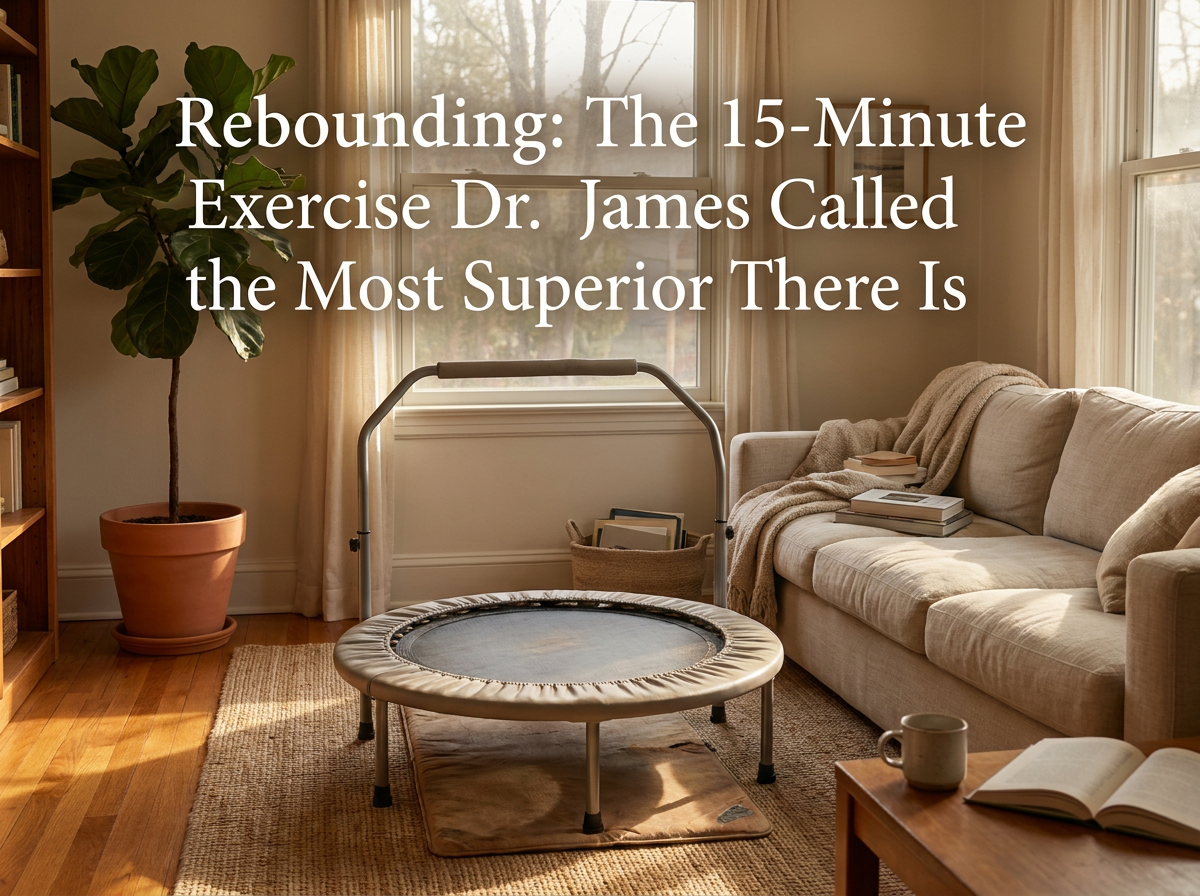
Rebounding: The 15-Minute Exercise Dr. James Called the Most Superior There Is

Dr. James had a test for exercise equipment.
He said you could tell the value of any piece of gear by how many clothes you could stack on it. On an exercise bike, maybe four or five hangers. On his rebounder? About eight feet of clothes.
It was a joke — but it landed because it was true. Most exercise equipment ends up as furniture. The rebounder was different. In our house, we have had two and three of them set up in the living room at once, right in front of the television, in a place of honor. Not folded away in a closet. Not tucked behind a couch. Front and center, because someone is always on one.
Between the two of us, we have owned at least six. They rotate through — bought, used, and then given away to someone who needs one more. Every grandchild who walks through the door climbs on. They do flips off the support bar like it is a trapeze. And in the process, without ever thinking of it as exercise, they are getting the single most complete workout available to the human body.
Dr. James called rebounding the most superior form of exercise there is. After decades of clinical practice and every approach he could try, that is where he landed.
Here is why.
Where This Came From: Bruno Gerzeli, 1978
Dr. James was introduced to the rebounder in the fall of 1978 by a man named Bruno Gerzeli.
Bruno was not a fitness guru. He was a professional footballer — a genuine one. Born in Monfalcone, Italy in 1925, he played for Venezia in Serie A, then Salernitana, then followed the wave of European players to Colombia during the well-paid "El Dorado" era of South American football, joining Deportivo Samarios. He came to Canada in 1954, playing in the National Soccer League with Toronto Hungaria and later Toronto Sparta. He moved his family to Utah in 1971, and in 1972 was hired as the soccer coach at Brigham Young University, where he had an enormous influence on youth soccer in Utah through the 1970s.
Bruno had connections to people at NASA. And that is how he learned what he passed on to Dr. James.
NASA had a problem. Astronauts returning from extended time in space came back with catastrophic muscle loss — the body, freed from gravity, simply stops maintaining what it does not need. Conventional exercise could not rebuild it. Nothing they tried restored muscle tone at anything close to an acceptable rate.
Then they put the astronauts on rebounders. And the muscle came back in record time — faster than any other form of exercise they had tested.
That is what Bruno told Dr. James in 1978.
Bruno Gerzeli died on November 8, 1982, in Salt Lake City. He was 57 years old. A heart attack — in a man who had been a professional athlete his entire life and was still actively coaching. Far too young.
Decades later, Dr. James was writing The Wisdom of Wellness, searching for the right exercise to pair with the vitamins and the herbs — the third leg of a complete wellness program. He tried everything. Studied everything. And he found himself right back at the very exercise a friend had told him about twenty-five years earlier.
That is not coincidence. That is something working.
Why Rebounding Works: The Lymphatic Key
Your circulatory system has a pump. It is called the heart, and it never stops.
Your lymphatic system has no pump at all.
The lymphatic system is the body's drainage and filtration network — the system that clears waste, transports immune cells, and removes what the body needs to eliminate. And it moves only when you move. Muscle contraction is the pump. Movement is the pump. Nothing else.
When people sit — when they stop moving — lymph stops moving with them. That is when you get edema, the fluid pooling in the legs and ankles that so many people simply accept as a fact of aging. It is not aging. It is a drainage system that has not been given a reason to run.
Here is what makes rebounding different from walking, or cycling, or almost anything else:
The up-and-down gravitational force specifically stimulates the valves in the lymphatic system in a way that horizontal movement does not. Every bounce cycles your entire body through increased G-force at the bottom and near-weightlessness at the top. That vertical compression and release is the exact mechanical signal the lymphatic valves respond to.
And it does not stop at the lymphatics.
At one of Dr. James's Wisdom of Wellness seminars, he would have someone get on the rebounder and start bouncing. Then he would have you place your hand flat on their back — and you could feel it. Every muscle contracting and releasing, contracting and releasing, with every single bounce.
That is happening head to toe. Every muscle in your body. And it goes all the way down to the cellular level — not just the muscles you can see, but every internal structure getting that same rhythmic stimulation.

Who Can Do This? Almost Everyone.
This is the part that surprises people.
At that same seminar, a woman came in using a walker. She could barely walk. She listened to the whole presentation on rebounding, and at the end she said: I have got to try that.
She got up on the rebounder — it had a support bar she could hold — and she did the healthy bounce. Just a light, gentle bounce, feet barely leaving the mat.
Five minutes later she said she felt dramatically better.
Dr. James went further than that in his clinical work. He had patients who could not stand on the rebounder at all — so they sat on it. He had patients who were wheelchair-bound — so they placed their feet on the mat while someone else bounced. And even that transmitted motion was enough to stimulate lymphatic flow.
Rebounding is accessible to essentially anyone who can be near one.
For Athletes
Rebounding does not replace your training. It enhances it.
If you run, rebounding for a few minutes afterward improves muscle building and muscle repair. If you lift, the same. It helps move accumulated acid through and out of the system — balancing out what heavy training creates.
And it corrects imbalance. One of Dr. James's sons, in his late teens, was lifting weights with his cousins and could not get his sides even — his dominant right side was consistently building bigger than his left. He asked Dr. James what to take, what to do differently.
The answer: get on the rebounder.
He kept lifting. He just finished every workout with the rebounder. And because rebounding works both sides of the body identically and simultaneously, it balanced him out.
For Pregnancy
Lynn had her first six children without a rebounder. Her last two, there was one in the house.
The difference was night and day — in muscle tone, in circulation, in mental clarity, and in keeping her hips functioning properly. And that was on pregnancies seven and eight, when the body has already been through a great deal and the muscle corset is not what it once was.
The important caution: start early and build gradually. Do not decide to begin a vigorous rebounding routine in your third trimester. If you are new to it during pregnancy, you may simply stand on it while someone else bounces. Consult with your physician.
There is also this: our seventh child was holding her head up three days after she was born. Pushing herself up, almost. Whether that is the rebounder, we cannot prove — but she got all of that circulation and all of that G-force for nine months before she arrived, and she came out remarkably strong.
And after they were born, the rebounder was the thing that calmed them fastest. Nothing else would settle a fussy baby like sitting cross-legged on the rebounder, holding them, and gently bouncing. It was like they recognized it. Like coming home.
For Recovery
The NASA principle applies to anyone whose body has been down.
After surgery. After extended bed rest. After illness. When conventional exercise cannot restore muscle tone, rebounding does — and it does it faster than the alternatives.
The Full List of Benefits
Dr. James documented these in The Wisdom of Wellness:
Detox and Cellular
- Alkalizes the body — shifting away from the acidic environment where illness thrives
- Increases mitochondria count within the muscle — literally increasing your cells' energy-producing capacity
- Stimulates the body's own stem cell production
- Enhances digestion and elimination processes
- Minimizes colds, allergies, and digestive disturbances
- Prevents chronic edema — the fluid pooling that comes from a stagnant lymphatic system
Circulation and Cardiovascular
- Stimulates the valves of the lymphatic system — the core mechanism behind most of the rest
- Lowers cholesterol and triglyceride levels
- Increases the functional activity of red bone marrow — this one deserves explanation. Red bone marrow is where the body manufactures blood cells. Bone responds to mechanical loading, and every bounce delivers that loading through increased G-force at the bottom of the bounce. Your bones receive the signal to stay active and productive — and the marrow inside responds by increasing blood cell production.
- Makes oxygen more available throughout the body — a direct consequence of more red blood cells, which are the body's oxygen carriers
- Increases lung capacity
- Lessens the time blood pressure remains elevated after intense activity — recovery time matters as much as peak performance
- Strengthens the heart — the heart is a muscle, and rebounding works every muscle, including that one
Metabolic and Body Composition
- Improves resting metabolic rate — you burn more calories even at rest
- Improves muscle-to-fat ratio
- Curtails fatigue and menstrual discomfort — Lynn's experience is emphatic on this one: standing on the rebounder during menstrual discomfort relieves the pressure almost immediately
Structural and Protective
- Protects the body from the impact of exercising on hard surfaces — dramatically gentler on joints than running
- Promotes tissue repair — connected directly to increased blood cell production
- Enhances body alignment and posture
- Improves balance and coordination
- Relieves neck pain, back pain, and headaches
Mental and Immune
- Better mental performance — more oxygen reaching the brain
- Supports immune function at the cellular level — increased white blood cell activity is the body's front-line defense
- Improves relaxation and sleep — ten minutes on the rebounder before bed makes a substantial difference for people who struggle to fall asleep
- Slows the aging process — and this is visible. The repeated downward pull tones and firms tissue that most people cannot target with a hundred different targeted exercises
- Improved self-image and a genuine sense of control
- It is enjoyable — Dr. James put this on the list plainly, and it belongs there. An exercise you actually want to do is one you will actually keep doing
The Healthy Bounce: How to Start Correctly
This matters more than almost anything else in this article.
Start with the healthy bounce.
The healthy bounce means you stand on the mat and bounce lightly — using your full body weight, keeping your feet flat, letting your feet barely leave the mat or not leave it at all. You are not jumping. You are not doing tricks. You are not attempting whatever the instructional video that came with the rebounder is showing you. (We tried those exercises once. We lasted about fifteen seconds.)
Keep your feet flat. Do not go up on your toes — your calves will punish you the next day.
A few minutes a day for the first three days. That is it. That is where you start.
Why Starting Slow Actually Matters
Here is what happens when people start too hard: they get headaches. Their muscles hurt so badly they never get back on. And they conclude rebounding is not for them.
That is not the rebounder's fault. That is a detox reaction.
Rebounding stirs things up. If you have accumulated chemicals, pharmaceutical residues, or environmental toxins over a lifetime — and most of us have — they are stored in your tissues. In your fat. In your brain. Rebounding mobilizes them.
Start too aggressively and you can trigger a genuine cleansing crisis.
We knew someone who had been on steroids for asthma for years. She got a rebounder, started using it, and every single time — even for just two or three minutes — she got a massive headache. She asked her doctor about it, and even he confirmed it: the rebounding was pushing the steroids out of her cells, and the rapid mobilization was causing the headache.
She got rid of the rebounder.
That was the wrong answer. The right answer was to bounce lighter, go slower, and support the body while it cleared what it had been holding. On the other side of that detox is a life without those headaches — not just without rebounding headaches.
Pairing Rebounding With Herbal Cleanses
Rebounding does not just support a cleanse. It accelerates it — sometimes dramatically.
Because rebounding pushes nutrients deeper into the cells and moves everything through the system faster, herbal formulas work more powerfully when paired with it.
A word of practical warning, learned the hard way: one of our family members took herbs and then got on the rebounder, and had to get off very quickly and run for the bathroom. The rebounding drove the formula into their system fast enough that their bowels decided it was time to move — immediately.
So: Liv Clean or Klean Lax right before you get on the rebounder may not be a wise choice unless you are specifically hoping for that outcome. If you have been backed up and you want things moving, by all means. Otherwise, plan accordingly.
For cleansing support that pairs well with rebounding:
- Blood Wash — keeps the blood clean as the lymphatics dump what they are clearing into it
- Detoxalation — mobilizes and clears the heavy metals and pharmaceutical residues that rebounding stirs up
- Bladney — supports the kidneys and bladder as they process the increased load
If you begin rebounding and experience detox symptoms, this is exactly when to reach for these formulas rather than to quit.
Buying a Rebounder: They Are Not All Equal
This is important enough that it can determine whether rebounding helps you or hurts you.
You cannot buy a good rebounder at a big-box store. We have never seen one at a local sporting goods store worth having.
Here is the test: bounce on it. If it feels like you hit bottom — if there is a hard, jarring stop rather than a gradual deceleration that smoothly sends you back up — it is not a good rebounder.
That jarring impact is precisely what you are trying to avoid. It is the same taxing impact you get from jogging on pavement, which is one of the primary things rebounding is supposed to spare you from. A bad rebounder does more damage than good.
What to look for:
- Barrel-shaped springs — not straight springs of uniform width. The barrel shape is what produces the gradual, cushioned deceleration.
- A smooth return — you should feel the mat catch you and lift you, not stop you.
- Price — expect to pay a few hundred dollars new. If it is significantly cheaper than that new, be suspicious.
Brands we trust: Needak and ReboundAir. There are certainly others, but those are the two we come back to. ReboundAir is the primary one in our house.
The budget approach: Watch Facebook Marketplace. People buy rebounders in January as a New Year's resolution and sell them in March when the resolution fades. Lynn has bought most of hers for around fifty dollars this way. Just verify the brand.
Muscle Versus Fat: Ignore the Scale
If you start rebounding and watch the scale, you may get discouraged for entirely the wrong reason.
Muscle is denser than fat. A pound of fat takes up enormous space and weighs very little for its volume. Muscle is compact and heavy.
So when you start rebounding and your body begins burning fat and building muscle, the scale may not move. It may even go up — particularly if you had very little muscle tone to begin with.
Dr. James was emphatic about this. He said people get so caught up in the number on the scale that they lose track of whether they are actually getting healthier.
He knew someone who thought she was getting healthier because she had lost thirty pounds. She had lost thirty pounds of muscle — and traded it for fat.
That is not health. That is decline with a number that looks good.
Judge rebounding by:
- How you feel
- How your clothes fit
- Your energy level
- The glow of your skin — when circulation improves, people notice and ask what you are doing, and it often has nothing to do with your size
Your Thirty-Day Start
Fifteen minutes a day. Thirty days.
That is enough to build the habit and enough to notice a real difference.
Put the rebounder somewhere visible — in front of the television, not folded away in a closet. In our house it lives in the living room, and everyone who walks through gets exercise without ever once thinking of it as exercise.
Start with the healthy bounce. Feet flat, minimal lift, a few minutes at a time for the first three days.
Support the process with Blood Wash and Detoxalation if you experience detox symptoms.
And judge the results by how you feel — not by the scale.
If you want to try one out, come by the office. There is one sitting in there because Jim uses it constantly. And if you meet anyone in this family, they have a rebounder — and if they do not, we will probably find one to give them.
Frequently Asked Questions
Why is rebounding better than walking for the lymphatic system?
The lymphatic system has no pump and moves only through muscle contraction and body movement. Rebounding produces a repeated up-and-down gravitational force — increased G-force at the bottom of the bounce, near-weightlessness at the top — that specifically stimulates the one-way valves of the lymphatic system. This vertical compression-and-release pattern activates the lymphatic valves more effectively than the horizontal motion of walking, and it simultaneously contracts every muscle in the body from head to toe.
Can seniors or people with limited mobility use a rebounder?
Yes. Dr. James worked with patients who used walkers and simply held the support bar while doing a gentle healthy bounce. He also worked with wheelchair-bound patients who placed their feet on the mat while another person bounced — and even that transmitted motion stimulated lymphatic flow. Rebounding is accessible to nearly anyone who can be near one.
Is rebounding safe during pregnancy?
Rebounding during pregnancy is generally safe when started early and built gradually, and it offers substantial benefits for circulation, muscle tone, and hip function. The important caution is not to begin a vigorous new routine in the third trimester. If you are new to rebounding while pregnant, standing on the mat without bouncing is a reasonable starting point. Consult your physician about your specific situation.
Why do I get headaches when I start rebounding?
Headaches when beginning rebounding are typically a detox reaction. Rebounding mobilizes stored chemicals, pharmaceutical residues, and environmental toxins out of the cells and tissues where they have accumulated. When that mobilization happens faster than the body can clear it, symptoms result. The solution is to bounce more gently, keep sessions short, and support the body's elimination pathways with formulas like Blood Wash and Detoxalation — not to quit.
What should I look for when buying a rebounder?
Look for barrel-shaped springs rather than straight uniform springs, and test the bounce — a quality rebounder decelerates you gradually and returns you smoothly upward. If you feel a hard jarring stop at the bottom, the rebounder will do more harm than good. Expect to pay a few hundred dollars for a quality new rebounder. Needak and ReboundAir are two trusted brands. Quality used rebounders are often available secondhand for a fraction of retail.
How long does it take to see results from rebounding?
Fifteen minutes a day for thirty days is enough to establish the habit and see noticeable changes. Rather than watching the scale — which can be misleading because rebounding builds dense muscle while burning fat — judge progress by your energy, how your clothes fit, your sleep quality, and the visible improvement in your skin as circulation improves.
Jim and Lynn Applegate host the Reality of Herbal Therapy podcast. Lynn is the daughter of Dr. Michael James, founder of Professional Herbal Instruction and Dr. James' Herbal Formulas. The rebounding principles described in this article come from Dr. James's book The Wisdom of Wellness and over four decades of clinical practice beginning in 1980.
Professional Herbal Instruction | DrugFreeHelpStore.com | 888-388-4413